Allen Mouse Brain
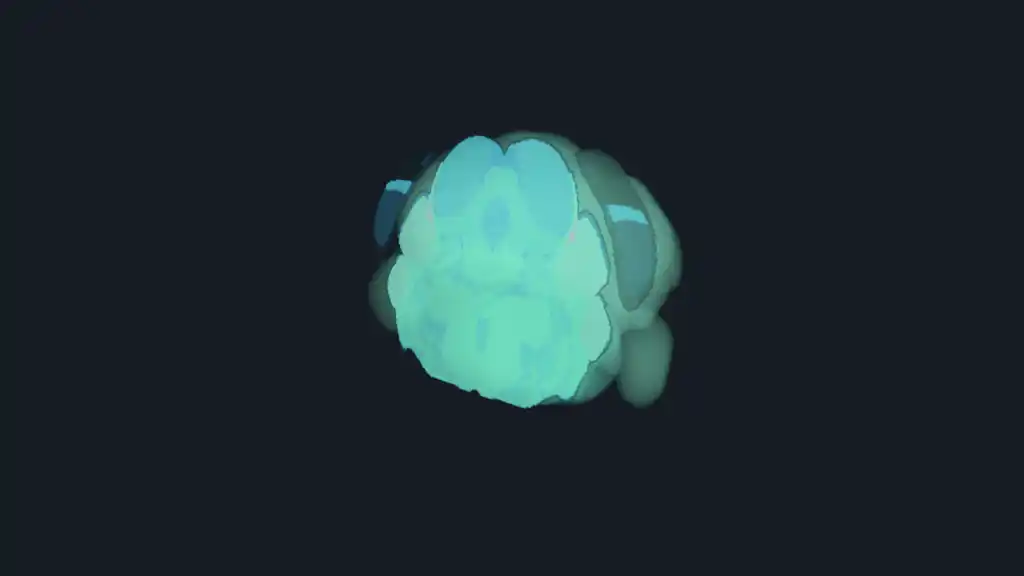
This example renders a prepared Allen mouse brain volume with a visible slice.
Preview
Run And Adapt
Commands below assume a Datoviz source checkout and start at the repository root. Use your configured build environment; Python routes additionally require local bindings.
| Route | Availability | Command or action |
|---|---|---|
| C | Canonical native source | just example-c showcases/brain_volume (build and run), or rerun ./build/examples/c/showcases/brain_volume |
| Python | Available | python3 -m examples.python.gallery.showcases.brain_volume |
| Browser | Planned | Use the native route for this example. |
Prepared data required
This example intentionally fails when its prepared input is absent; it does not
substitute synthetic data.
Expected input: data/examples/allen_ibl/prepared/allen_mouse_brain_rgba.npy.gz.
Prepare it from the repository root with python tools/data/prepare_brain_volume.py.
Use this example as capability or integration evidence, not as a minimal copy-paste template. Start from the nearest supported, copy-safe example and add this feature after verifying the linked API reference.
What To Look For
The loader reads the prepared compressed NumPy RGBA volume, downsamples it, derives scalar voxels for occlusion, and binds the same 3D sampled field to a composite volume and a slice visual. Compare the translucent context volume with the sharper slice plane while using the arcball camera.
This workflow is useful for volume-data previews where a slice should stay spatially embedded in the 3D anatomy. The prepared data-submodule file must exist, or it must be generated with the preparation command.
Data: data/examples/allen_ibl/prepared/allen_mouse_brain_rgba.npy.gz
Prepare: python tools/data/prepare_brain_volume.py
Source
#!/usr/bin/env python3
"""Prepared Allen mouse brain volume with an embedded slice."""

from __future__ import annotations

import ctypes
import gzip
from pathlib import Path

import numpy as np

import datoviz as dvz

from examples.python.gallery import common as ex


DATA_PATH = Path("data/examples/allen_ibl/prepared/allen_mouse_brain_rgba.npy.gz")
RAW_SHAPE = (528, 456, 320, 4)
DOWNSAMPLE = 2
SLICE_AXIS = dvz.DVZ_VOLUME_AXIS_Y
SLICE_POSITION = 0.50
VOLUME_OPACITY = 0.85
SLICE_OPACITY = 1.0
VOLUME_STEPS = 192
BRAIN_SCALAR_TISSUE_FLOOR = 32
INITIAL_ANGLES = (ctypes.c_float * 3)(-0.42, +0.26, -0.16)

FRAME_BG = dvz.DvzColor(13, 18, 24, 255)
PANEL_BG = dvz.DvzColor(18, 25, 32, 255)
CYAN = dvz.DvzColor(76, 201, 240, 255)
MINT = dvz.DvzColor(128, 255, 219, 255)
TEXT = dvz.DvzColor(217, 226, 236, 255)


def _load_rgba(path: Path = DATA_PATH) -> np.ndarray:
    if not path.exists():
        raise FileNotFoundError(
            f"{path} is missing; run `python tools/data/prepare_brain_volume.py`"
        )
    with gzip.open(path, "rb") as f:
        rgba = np.load(f, allow_pickle=False)
    if rgba.shape != RAW_SHAPE or rgba.dtype != np.uint8:
        raise ValueError(f"unexpected Allen mouse brain volume: {rgba.shape} {rgba.dtype}")
    return np.ascontiguousarray(rgba)


def _downsample_strongest(rgba: np.ndarray, factor: int = DOWNSAMPLE) -> np.ndarray:
    if factor <= 1:
        return rgba
    depth, height, width, channels = rgba.shape
    if channels != 4 or depth % factor != 0 or height % factor != 0 or width % factor != 0:
        raise ValueError("brain volume dimensions must be divisible by the downsample factor")

    out_shape = (depth // factor, height // factor, width // factor, 4)
    best = np.zeros(out_shape, dtype=np.uint8)
    best_score = np.zeros(out_shape[:3], dtype=np.uint32)

    for z in range(factor):
        for y in range(factor):
            for x in range(factor):
                candidate = rgba[z::factor, y::factor, x::factor, :]
                luma = (
                    candidate[..., 0].astype(np.uint32)
                    + candidate[..., 1].astype(np.uint32)
                    + candidate[..., 2].astype(np.uint32)
                )
                score = candidate[..., 3].astype(np.uint32) * np.uint32(1024) + luma
                mask = score > best_score
                best_score[mask] = score[mask]
                best[mask] = candidate[mask]
    return best


def _normalize_alpha(rgba: np.ndarray) -> None:
    alpha = rgba[..., 3]
    max_alpha = int(alpha.max(initial=0))
    if max_alpha == 0 or max_alpha == 255:
        return
    visible = alpha > 0
    scaled = (alpha[visible].astype(np.uint32) * 255 + max_alpha // 2) // max_alpha
    alpha[visible] = np.clip(scaled, 0, 255).astype(np.uint8)


def _scalar_volume(rgba: np.ndarray) -> np.ndarray:
    alpha = rgba[..., 3]
    luma = (
        77 * rgba[..., 0].astype(np.uint32)
        + 150 * rgba[..., 1].astype(np.uint32)
        + 29 * rgba[..., 2].astype(np.uint32)
        + 128
    ) // 256
    scalar = np.where(alpha > 0, luma, 0).astype(np.uint8)
    signal = scalar[scalar > 0]
    if signal.size == 0:
        return scalar
    min_signal = int(signal.min())
    max_signal = int(signal.max())
    if max_signal <= min_signal:
        return scalar

    visible = scalar > 0
    stretched = (
        BRAIN_SCALAR_TISSUE_FLOOR
        + (
            (scalar[visible].astype(np.uint32) - min_signal)
            * (255 - BRAIN_SCALAR_TISSUE_FLOOR)
            + (max_signal - min_signal) // 2
        )
        // (max_signal - min_signal)
    )
    scalar[visible] = np.clip(stretched, 0, 255).astype(np.uint8)
    return np.ascontiguousarray(scalar)


def _load_scalar_volume(path: Path = DATA_PATH) -> np.ndarray:
    rgba = _load_rgba(path)
    downsampled = _downsample_strongest(rgba)
    del rgba
    _normalize_alpha(downsampled)
    return _scalar_volume(downsampled)


def _volume_bounds(width: int, height: int, depth: int):
    max_dim = max(width, height, depth, 1)
    sx = width / max_dim
    sy = height / max_dim
    sz = depth / max_dim
    return (ctypes.c_double * 3)(-sx, -sy, -sz), (ctypes.c_double * 3)(+sx, +sy, +sz)


def _attach_transfer(scene, visual, *, slice_visual: bool) -> None:
    desc = dvz.dvz_scale_desc()
    desc.kind = dvz.DVZ_SCALE_CONTINUOUS
    desc.label = b"brain density"
    scale = dvz.dvz_scale(scene, ctypes.byref(desc))
    if not scale:
        raise RuntimeError("dvz_scale() failed")
    if dvz.dvz_scale_set_domain(scale, 0.0, 1.0) != 0:
        raise RuntimeError("dvz_scale_set_domain() failed")

    colormap = dvz.dvz_colormap(scene, None)
    if not colormap:
        raise RuntimeError("dvz_colormap() failed")
    stop_values = (
        (0.00, (FRAME_BG.r, FRAME_BG.g, FRAME_BG.b, 255)),
        (0.10, (PANEL_BG.r, PANEL_BG.g, PANEL_BG.b, 255)),
        (0.26, (24, 64, 82, 255)),
        (0.48, (CYAN.r, CYAN.g, CYAN.b, 255)),
        (0.70, (MINT.r, MINT.g, MINT.b, 255)),
        (0.90, (MINT.r, MINT.g, MINT.b, 255)),
        (1.00, (TEXT.r, TEXT.g, TEXT.b, 255)),
    )
    stops = (dvz.DvzColormapStop * len(stop_values))()
    for stop, (position, rgba) in zip(stops, stop_values, strict=True):
        stop.position = position
        stop.rgba[:] = rgba
    if dvz.dvz_colormap_set_stops(colormap, stops, len(stops)) != 0:
        raise RuntimeError("dvz_colormap_set_stops() failed")
    if dvz.dvz_scale_set_colormap(scale, colormap) != 0:
        raise RuntimeError("dvz_scale_set_colormap() failed")

    alpha_values = (
        ((0.00, 0.00), (0.01, 0.00), (0.03, 1.00), (1.00, 1.00))
        if slice_visual
        else (
            (0.00, 0.00),
            (0.12, 0.00),
            (0.24, 0.06),
            (0.42, 0.22),
            (0.62, 0.46),
            (0.84, 0.74),
            (1.00, 0.90),
        )
    )
    alpha = (dvz.DvzVolumeAlphaStop * len(alpha_values))()
    for stop, (position, opacity) in zip(alpha, alpha_values, strict=True):
        stop.position = position
        stop.alpha = opacity
    if dvz.dvz_volume_set_alpha_stops(visual, alpha, len(alpha)) != 0:
        raise RuntimeError("dvz_volume_set_alpha_stops() failed")
    if dvz.dvz_visual_set_scale(visual, b"color", scale) != 0:
        raise RuntimeError("dvz_visual_set_scale() failed")


def _configure_volume_pair(volume, slice_visual, scalar: np.ndarray) -> None:
    # Raw texture axes are DV, ML, AP; scene axes are ML, reversed AP, reversed DV.
    axis_order = (ctypes.c_uint32 * 3)(2, 0, 1)
    axis_flip = (ctypes.c_bool * 3)(True, False, True)
    for visual in (volume, slice_visual):
        if dvz.dvz_visual_set_alpha_mode(visual, dvz.DVZ_ALPHA_BLENDED) != 0:
            raise RuntimeError("dvz_visual_set_alpha_mode() failed")
        if dvz.dvz_volume_set_sampling(visual, dvz.DVZ_VOLUME_SAMPLING_LINEAR) != 0:
            raise RuntimeError("dvz_volume_set_sampling() failed")
        if dvz.dvz_volume_set_axis_mapping(visual, axis_order, axis_flip) != 0:
            raise RuntimeError("dvz_volume_set_axis_mapping() failed")

    depth, height, width = scalar.shape
    display_width = height
    display_height = depth
    display_depth = width
    bmin, bmax = _volume_bounds(display_width, display_height, display_depth)
    for visual in (volume, slice_visual):
        if dvz.dvz_volume_set_bounds(visual, bmin, bmax) != 0:
            raise RuntimeError("dvz_volume_set_bounds() failed")

    if dvz.dvz_volume_set_render_mode(volume, dvz.DVZ_VOLUME_RENDER_COMPOSITE) != 0:
        raise RuntimeError("dvz_volume_set_render_mode(volume) failed")
    if dvz.dvz_volume_set_value_range(volume, 0.04, 1.0) != 0:
        raise RuntimeError("dvz_volume_set_value_range(volume) failed")
    if dvz.dvz_volume_set_opacity(volume, VOLUME_OPACITY) != 0:
        raise RuntimeError("dvz_volume_set_opacity(volume) failed")
    if dvz.dvz_volume_set_step_count(volume, VOLUME_STEPS) != 0:
        raise RuntimeError("dvz_volume_set_step_count(volume) failed")
    clip_min = (ctypes.c_double * 3)(0.0, 0.0, 0.0)
    clip_max = (ctypes.c_double * 3)(1.0, SLICE_POSITION, 1.0)
    if dvz.dvz_volume_set_clipping_box(volume, clip_min, clip_max) != 0:
        raise RuntimeError("dvz_volume_set_clipping_box() failed")

    if dvz.dvz_volume_set_render_mode(slice_visual, dvz.DVZ_VOLUME_RENDER_SLICE) != 0:
        raise RuntimeError("dvz_volume_set_render_mode(slice) failed")
    if dvz.dvz_volume_set_value_range(slice_visual, 0.0, 1.0) != 0:
        raise RuntimeError("dvz_volume_set_value_range(slice) failed")
    if dvz.dvz_volume_set_opacity(slice_visual, SLICE_OPACITY) != 0:
        raise RuntimeError("dvz_volume_set_opacity(slice) failed")
    if dvz.dvz_volume_set_slice_axis(slice_visual, SLICE_AXIS) != 0:
        raise RuntimeError("dvz_volume_set_slice_axis() failed")
    if dvz.dvz_volume_set_slice_position(slice_visual, SLICE_POSITION) != 0:
        raise RuntimeError("dvz_volume_set_slice_position() failed")


def _enable_volume_occlusion(panel, volume, slice_visual) -> None:
    desc = dvz.dvz_volume_occlusion_desc()
    desc.enabled = True
    desc.alpha_threshold = 0.000001
    desc.fade_distance = 0.000001
    desc.occluded_alpha = 0.097
    if dvz.dvz_panel_set_volume_occluder(panel, volume, ctypes.byref(desc)) != 0:
        raise RuntimeError("dvz_panel_set_volume_occluder() failed")
    if dvz.dvz_visual_set_scene_occluder(volume, False) != 0:
        raise RuntimeError("dvz_visual_set_scene_occluder() failed")
    if dvz.dvz_visual_set_volume_occluded(slice_visual, True) != 0:
        raise RuntimeError("dvz_visual_set_volume_occluded() failed")
    if dvz.dvz_visual_set_scene_occluded(slice_visual, False) != 0:
        raise RuntimeError("dvz_visual_set_scene_occluded() failed")
    if dvz.dvz_panel_set_scene_occlusion(panel, None) != 0:
        raise RuntimeError("dvz_panel_set_scene_occlusion() failed")


def _set_capabilities(scene) -> None:
    caps = dvz.dvz_capability_snapshot()
    caps.max_color_attachments = 3
    caps.render_target_format_rgba16float = True
    caps.render_target_format_r16float = True
    caps.supports_render_target_sampling = True
    caps.supports_color_blending = True
    if dvz.dvz_scene_set_capabilities(scene, ctypes.byref(caps)) != 0:
        raise RuntimeError("dvz_scene_set_capabilities() failed")


def _setup_camera(panel) -> None:
    camera = dvz.dvz_camera_desc()
    camera.view.eye[:] = (-1.55, 1.58, -2.45)
    camera.view.target[:] = (0.0, 0.0, 0.0)
    camera.view.up[:] = (0.0, 1.0, 0.0)
    camera.projection.fov_y = 0.72
    camera.projection.near_clip = 0.01
    camera.projection.far_clip = 100.0
    if dvz.dvz_panel_set_camera_desc(panel, ctypes.byref(camera)) != 0:
        raise RuntimeError("dvz_panel_set_camera_desc() failed")


def _add_volume_pair(scene, panel, scalar: np.ndarray):
    field = dvz.dvz_sampled_field_from_array(
        scene,
        scalar,
        format=dvz.DVZ_FIELD_FORMAT_R8_UNORM,
        semantic=dvz.DVZ_FIELD_SEMANTIC_SCALAR,
        dim=dvz.DVZ_FIELD_DIM_3D,
    )
    volume = dvz.dvz_volume(scene, 0)
    slice_visual = dvz.dvz_volume(scene, 0)
    if not volume or not slice_visual:
        raise RuntimeError("dvz_volume() failed")
    if dvz.dvz_visual_set_field(volume, b"field", field) != 0:
        raise RuntimeError("dvz_visual_set_field(volume) failed")
    if dvz.dvz_visual_set_field(slice_visual, b"field", field) != 0:
        raise RuntimeError("dvz_visual_set_field(slice) failed")

    _attach_transfer(scene, volume, slice_visual=False)
    _attach_transfer(scene, slice_visual, slice_visual=True)
    _configure_volume_pair(volume, slice_visual, scalar)

    volume_attach = dvz.dvz_visual_attach_desc()
    volume_attach.z_layer = 0
    volume_attach.controller_mode = dvz.DVZ_CONTROLLER_APPLY
    slice_attach = dvz.dvz_visual_attach_desc()
    slice_attach.z_layer = 1
    slice_attach.controller_mode = dvz.DVZ_CONTROLLER_APPLY
    if dvz.dvz_panel_add_visual(panel, volume, ctypes.byref(volume_attach)) != 0:
        raise RuntimeError("dvz_panel_add_visual(volume) failed")
    if dvz.dvz_panel_add_visual(panel, slice_visual, ctypes.byref(slice_attach)) != 0:
        raise RuntimeError("dvz_panel_add_visual(slice) failed")

    _enable_volume_occlusion(panel, volume, slice_visual)
    return volume, slice_visual


def _build_scene(path: Path = DATA_PATH):
    scalar = _load_scalar_volume(path)
    scene = dvz.dvz_scene()
    if not scene:
        raise RuntimeError("dvz_scene() failed")
    _set_capabilities(scene)
    figure = dvz.dvz_figure(scene, ex.WIDTH, ex.HEIGHT, 0)
    if not figure:
        dvz.dvz_scene_destroy(scene)
        raise RuntimeError("dvz_figure() failed")
    panel = dvz.dvz_panel_full(figure)
    if not panel:
        dvz.dvz_scene_destroy(scene)
        raise RuntimeError("dvz_panel_full() failed")
    dvz.dvz_panel_set_background_color(panel, PANEL_BG)
    _setup_camera(panel)
    volume, slice_visual = _add_volume_pair(scene, panel, scalar)
    return scene, figure, panel, volume, slice_visual, scalar.shape


def _configure_view(view, scene, panel) -> None:
    controller = dvz.dvz_arcball(scene, None)
    if not controller:
        raise RuntimeError("dvz_arcball() failed")
    if dvz.dvz_view_bind_controller(view, panel, controller, dvz.DVZ_DIM_MASK_XYZ) != 0:
        raise RuntimeError("dvz_view_bind_controller() failed")
    arcball = dvz.dvz_controller_arcball(controller)
    if not arcball:
        raise RuntimeError("dvz_controller_arcball() failed")
    if dvz.dvz_arcball_set(arcball, INITIAL_ANGLES) != 0:
        raise RuntimeError("dvz_arcball_set() failed")


def main() -> None:
    scene, figure, panel, _volume, _slice, shape = _build_scene()
    print(f"loaded downsampled Allen mouse brain scalar volume {shape[2]}x{shape[1]}x{shape[0]}")

    def configure(view) -> None:
        _configure_view(view, scene, panel)

    ex.run_with_view(scene, figure, "Allen Mouse Brain", configure)


if __name__ == "__main__":
    main()
/*
* Copyright (c) 2021 Cyrille Rossant and contributors. All rights reserved.
* Licensed under the MIT license. See LICENSE file in the project root for details.
* SPDX-License-Identifier: MIT
*/
/* brain_volume - This example renders a prepared Allen mouse brain volume with a visible slice.
*
* What to look for: the loader reads the prepared compressed NumPy RGBA volume, downsamples it,
* derives scalar voxels for occlusion, and binds the same 3D sampled field to a composite volume and
* a slice visual. Compare the translucent context volume with the sharper slice plane while using
* the arcball camera.
*
* This workflow is useful for volume-data previews where a slice should stay spatially embedded in
* the 3D anatomy. The prepared data-submodule file must exist, or it must be generated with the
* preparation command.
*
* Scenario: showcases_brain_volume
* Style: showcase, graphite_cyan, 1280x720 window target
*
* Build: just example-c showcases/brain_volume
* Run: ./build/examples/c/showcases/brain_volume --live
* Smoke: ./build/examples/c/showcases/brain_volume --png
* Data: data/examples/allen_ibl/prepared/allen_mouse_brain_rgba.npy.gz
* Prepare: python tools/data/prepare_brain_volume.py
*/
/*************************************************************************************************/
/* Includes */
/*************************************************************************************************/
#include <ctype.h>
#include <math.h>
#include <stdbool.h>
#include <stdint.h>
#include <stdio.h>
#include <stdlib.h>
#include <string.h>
#include "_alloc.h"
#include "_assertions.h"
#include "_compat.h"
#include "_overflow.h"
#include "datoviz/fileio.h"
#include "datoviz/scene.h"
#include "example_common.h"
#include "example_style.h"
#include "example_tuner.h"
#include "runner/scenario_runner.h"
/*************************************************************************************************/
/* Constants */
/*************************************************************************************************/
#define WIDTH EXAMPLE_WINDOW_WIDTH
#define HEIGHT EXAMPLE_WINDOW_HEIGHT
#define DEFAULT_DATA_PATH "data/examples/allen_ibl/prepared/allen_mouse_brain_rgba.npy.gz"
#define DEFAULT_AXIS DVZ_VOLUME_AXIS_Y
#define DEFAULT_SLICE_POS 0.5f
#define DEFAULT_SLICE_OPACITY 0.5f
#define DEFAULT_VOLUME_OPACITY 0.8f
#define DEFAULT_VOLUME_STEPS 80.0f
#define DEFAULT_DOWNSAMPLE 2u
#define DEFAULT_OCCLUSION_THRESHOLD 0.000001f
#define DEFAULT_OCCLUSION_FADE 0.000001f
#define DEFAULT_OCCLUSION_HIDDEN_ALPHA 0.097f
#define MOUSE_BRAIN_WIDTH 320
#define MOUSE_BRAIN_HEIGHT 456
#define MOUSE_BRAIN_DEPTH 528
#define BRAIN_SCALAR_TISSUE_FLOOR 32u
static const double TAU = 6.28318530718;
/*************************************************************************************************/
/* Structs */
/*************************************************************************************************/
typedef struct AllenMouseBrainVolume
{
char* raw_data;
uint8_t* downsampled_data;
uint8_t* voxels;
uint8_t* scalar_voxels;
uint32_t width;
uint32_t height;
uint32_t depth;
uint32_t downsample;
} AllenMouseBrainVolume;
typedef struct BrainVolumeState
{
AllenMouseBrainVolume volume_data;
DvzVisual* volume_3d;
DvzVisual* volume_slice;
ExampleTuner tuner;
} BrainVolumeState;
/*************************************************************************************************/
/* Helpers */
/*************************************************************************************************/
/**
* Skip ASCII spaces.
*
* @param p current pointer
* @param end one-past-end pointer
* @return first non-space pointer
*/
static const char* _skip_spaces(const char* p, const char* end)
{
ANN(p);
ANN(end);
while (p < end && isspace((uint8_t)(*p)))
p++;
return p;
}
/**
* Parse a NumPy 64-bit little-endian u16.
*
* @param p pointer to input bytes
* @return parsed uint16 value
*/
static uint16_t _u16_le(const uint8_t* p)
{
ANN(p);
return (uint16_t)p[0] | ((uint16_t)p[1] << 8u);
}
/**
* Parse a NumPy 32-bit little-endian u32.
*
* @param p pointer to input bytes
* @return parsed uint32 value
*/
static uint32_t _u32_le(const uint8_t* p)
{
ANN(p);
return (uint32_t)p[0] | ((uint32_t)p[1] << 8u) | ((uint32_t)p[2] << 16u) |
((uint32_t)p[3] << 24u);
}
/**
* Extract a quoted header value after a known key.
*
* @param header header string
* @param header_end one-past-end pointer
* @param key key name to locate
* @param out output string
* @param out_size output size
* @return whether parsing succeeded
*/
static bool _parse_key_quoted_value(
const char* header, const char* header_end, const char* key, char* out, size_t out_size)
{
ANN(header);
ANN(header_end);
ANN(key);
ANN(out);
if (out_size == 0)
return false;
const char* key_pos = strstr(header, key);
if (key_pos == NULL || key_pos >= header_end)
return false;
const char* colon = strchr(key_pos, ':');
if (colon == NULL || colon >= header_end)
return false;
colon = _skip_spaces(colon + 1, header_end);
char quote = *colon;
if (quote != '\'' && quote != '\"')
return false;
colon++;
const char* closing = strchr(colon, quote);
if (closing == NULL || closing <= colon || closing > header_end)
return false;
size_t value_len = (size_t)(closing - colon);
if (value_len >= out_size)
return false;
dvz_memcpy(out, out_size, colon, value_len);
out[value_len] = '\0';
return true;
}
/**
* Parse the NPY shape tuple.
*
* @param header start of header text
* @param header_end one-past-end pointer
* @param dims output shape dimensions
* @param max_dims max number of dimensions
* @param out_count actual number of parsed dimensions
* @return whether shape parsing succeeded
*/
static bool _parse_shape(
const char* header, const char* header_end, uint32_t dims[], uint32_t max_dims,
uint32_t* out_count)
{
ANN(header);
ANN(header_end);
ANN(dims);
ANN(out_count);
const char* shape_key = strstr(header, "'shape'");
if (shape_key == NULL || shape_key >= header_end)
shape_key = strstr(header, "\"shape\"");
if (shape_key == NULL || shape_key >= header_end)
return false;
const char* open = strchr(shape_key, '(');
if (open == NULL || open >= header_end)
return false;
const char* close = strchr(open, ')');
if (close == NULL || close <= open || close > header_end)
return false;
uint32_t count = 0;
const char* p = open + 1;
while (p < close && count < max_dims)
{
p = _skip_spaces(p, close);
if (p >= close)
break;
if (!isdigit((uint8_t)(*p))
|| *p == ',')
{
p++;
continue;
}
char* next = NULL;
unsigned long value = strtoul(p, &next, 10);
if (next == NULL || next == p)
return false;
dims[count++] = (uint32_t)value;
p = next;
if (p < close)
p++;
}
if (count == 0)
return false;
*out_count = count;
return true;
}
/**
* Parse a NumPy header for an expected unsigned RGBA8 C-order 3D array.
*
* @param data decompressed NPY content
* @param size decompressed size in bytes
* @param out output parsed volume metadata
* @return whether the header matches expectations
*/
static bool _parse_allen_mouse_brain_npy(
char* data, DvzSize size, AllenMouseBrainVolume* out)
{
ANN(data);
ANN(out);
if (size < 10)
return false;
const uint8_t* bytes = (const uint8_t*)data;
if (memcmp(bytes, "\x93NUMPY", 6) != 0)
return false;
uint8_t major = bytes[6];
uint8_t minor = bytes[7];
(void)minor;
uint64_t header_len = 0;
if (major == 1)
{
if (size < 12)
return false;
header_len = _u16_le(bytes + 8);
}
else if (major == 2 || major == 3)
{
if (size < 14)
return false;
header_len = _u32_le(bytes + 8);
}
else
return false;
size_t header_start = 10;
size_t header_end = header_start + (size_t)header_len;
if (header_end > size || header_end <= header_start)
return false;
const char* header = (const char*)bytes + header_start;
const char* header_limit = header + header_len;
char descr[8] = {0};
if (!_parse_key_quoted_value(header, header_limit, "'descr'", descr, sizeof(descr)) &&
!_parse_key_quoted_value(header, header_limit, "\"descr\"", descr, sizeof(descr)))
return false;
if (strcmp(descr, "|u1") != 0)
return false;
const char* fortran_key = strstr(header, "'fortran_order'");
if (fortran_key == NULL || fortran_key >= header_limit)
fortran_key = strstr(header, "\"fortran_order\"");
if (fortran_key == NULL || fortran_key >= header_limit)
return false;
const char* fortran_colon = strchr(fortran_key, ':');
if (fortran_colon == NULL || fortran_colon >= header_limit)
return false;
const char* fortran_value = _skip_spaces(fortran_colon + 1, header_limit);
if (strncmp(fortran_value, "False", 5) != 0)
return false;
uint32_t dims[5] = {0};
uint32_t dims_count = 0;
if (!_parse_shape(header, header_limit, dims, 5, &dims_count))
return false;
uint32_t width = 0;
uint32_t height = 0;
uint32_t depth = 0;
if (dims_count == 3)
{
if (dims[0] != MOUSE_BRAIN_WIDTH || dims[1] != MOUSE_BRAIN_HEIGHT ||
dims[2] != MOUSE_BRAIN_DEPTH)
return false;
width = MOUSE_BRAIN_WIDTH;
height = MOUSE_BRAIN_HEIGHT;
depth = MOUSE_BRAIN_DEPTH;
}
else if (dims_count == 4)
{
if (dims[3] != 4 || dims[0] != MOUSE_BRAIN_DEPTH || dims[1] != MOUSE_BRAIN_HEIGHT ||
dims[2] != MOUSE_BRAIN_WIDTH)
return false;
width = MOUSE_BRAIN_WIDTH;
height = MOUSE_BRAIN_HEIGHT;
depth = MOUSE_BRAIN_DEPTH;
}
else
return false;
uint64_t payload_size = 0;
if (_dvz_mul_u64_overflows((uint64_t)width, (uint64_t)height, &payload_size) ||
_dvz_mul_u64_overflows(payload_size, depth, &payload_size) ||
_dvz_mul_u64_overflows(payload_size, 4, &payload_size))
return false;
if (size < header_end || (DvzSize)(size - header_end) != payload_size)
return false;
out->raw_data = data;
out->voxels = (uint8_t*)(data + header_end);
out->width = width;
out->height = height;
out->depth = depth;
return true;
}
/**
* Read and validate the Allen mouse brain RGBA dataset.
*
* @param path file path
* @param out output metadata and owned raw buffer
* @return whether the dataset was read and validated
*/
static bool _read_allen_mouse_brain(const char* path, AllenMouseBrainVolume* out)
{
ANN(path);
ANN(out);
if (out->raw_data != NULL)
return false;
DvzSize raw_size = 0;
char* raw = dvz_read_gz(path, &raw_size);
if (raw == NULL || raw_size == 0)
return false;
AllenMouseBrainVolume parsed = {0};
if (!_parse_allen_mouse_brain_npy(raw, raw_size, &parsed))
{
dvz_free(raw);
dvz_fprintf(stderr, "invalid Allen mouse brain .npy payload in %s\n", path);
return false;
}
out->raw_data = parsed.raw_data;
out->voxels = parsed.voxels;
out->width = parsed.width;
out->height = parsed.height;
out->depth = parsed.depth;
out->downsample = 1;
return true;
}
/**
* Return the ceiling of an unsigned integer division.
*
* @param value dividend
* @param divisor divisor
* @return ceil(value / divisor), or zero when divisor is zero
*/
static uint32_t _ceil_div_u32(uint32_t value, uint32_t divisor)
{
if (divisor == 0)
return 0;
return value / divisor + (value % divisor != 0 ? 1u : 0u);
}
/**
* Return the larger of two unsigned 32-bit integers.
*
* @param a first value
* @param b second value
* @return max(a, b)
*/
static uint32_t _max_u32(uint32_t a, uint32_t b)
{
return a > b ? a : b;
}
/**
* Downsample an RGBA volume by selecting the strongest voxel in every block.
*
* @param volume volume metadata and storage
* @param factor integer downsample factor
* @return whether downsampling succeeded
*/
static bool _downsample_allen_mouse_brain(AllenMouseBrainVolume* volume, uint32_t factor)
{
ANN(volume);
if (factor <= 1)
return true;
if (volume->voxels == NULL || volume->width == 0 || volume->height == 0 || volume->depth == 0)
return false;
uint32_t out_width = _ceil_div_u32(volume->width, factor);
uint32_t out_height = _ceil_div_u32(volume->height, factor);
uint32_t out_depth = _ceil_div_u32(volume->depth, factor);
if (out_width == 0 || out_height == 0 || out_depth == 0)
return false;
uint64_t voxel_count = 0;
uint64_t byte_count = 0;
if (_dvz_mul_u64_overflows(out_width, out_height, &voxel_count) ||
_dvz_mul_u64_overflows(voxel_count, out_depth, &voxel_count) ||
_dvz_mul_u64_overflows(voxel_count, 4, &byte_count))
{
return false;
}
uint8_t* dst = (uint8_t*)dvz_calloc(byte_count, 1);
if (dst == NULL)
return false;
const uint8_t* src = volume->voxels;
uint32_t src_width = volume->width;
uint32_t src_height = volume->height;
uint32_t src_depth = volume->depth;
for (uint32_t z = 0; z < out_depth; z++)
{
uint32_t z0 = z * factor;
uint32_t z1 = _max_u32(z0 + 1, z0 + factor);
if (z1 > src_depth)
z1 = src_depth;
for (uint32_t y = 0; y < out_height; y++)
{
uint32_t y0 = y * factor;
uint32_t y1 = _max_u32(y0 + 1, y0 + factor);
if (y1 > src_height)
y1 = src_height;
for (uint32_t x = 0; x < out_width; x++)
{
uint32_t x0 = x * factor;
uint32_t x1 = _max_u32(x0 + 1, x0 + factor);
if (x1 > src_width)
x1 = src_width;
const uint8_t* best = NULL;
uint32_t best_score = 0;
for (uint32_t zz = z0; zz < z1; zz++)
{
for (uint32_t yy = y0; yy < y1; yy++)
{
for (uint32_t xx = x0; xx < x1; xx++)
{
uint64_t src_index =
(((uint64_t)zz * src_height + yy) * src_width + xx) * 4u;
const uint8_t* candidate = src + src_index;
uint32_t luminance = (uint32_t)candidate[0] + candidate[1] +
candidate[2];
uint32_t score = (uint32_t)candidate[3] * 1024u + luminance;
if (best == NULL || score > best_score)
{
best = candidate;
best_score = score;
}
}
}
}
uint64_t dst_index = (((uint64_t)z * out_height + y) * out_width + x) * 4u;
if (best != NULL)
dvz_memcpy(dst + dst_index, 4, best, 4);
}
}
}
volume->downsampled_data = dst;
volume->voxels = dst;
volume->width = out_width;
volume->height = out_height;
volume->depth = out_depth;
volume->downsample = factor;
return true;
}
/**
* Return the raw Allen texture-axis mapping into IBL scene axes.
*
* The raw texture is stored as DV, ML, AP. The IBL scene axes are ML, reversed AP, reversed DV.
*
* @param axis_order output texture-axis source order
* @param axis_flip output per-texture-axis flip flags
*/
static void _allen_mouse_brain_axis_mapping(uint32_t axis_order[3], bool axis_flip[3])
{
ANN(axis_order);
ANN(axis_flip);
axis_order[0] = 2; /* texture DV samples scene Z. */
axis_order[1] = 0; /* texture ML samples scene X. */
axis_order[2] = 1; /* texture AP samples scene Y. */
axis_flip[0] = true;
axis_flip[1] = false;
axis_flip[2] = true;
}
/**
* Normalize the Allen RGBA alpha channel for display transfer.
*
* @param volume volume metadata and storage
*/
static void _normalize_allen_alpha(AllenMouseBrainVolume* volume)
{
ANN(volume);
if (volume->voxels == NULL)
return;
uint64_t voxel_count = 0;
if (_dvz_mul_u64_overflows(volume->width, volume->height, &voxel_count) ||
_dvz_mul_u64_overflows(voxel_count, volume->depth, &voxel_count))
{
return;
}
uint8_t max_alpha = 0;
for (uint64_t i = 0; i < voxel_count; i++)
{
uint8_t alpha = volume->voxels[4 * i + 3];
if (alpha > max_alpha)
max_alpha = alpha;
}
if (max_alpha == 0 || max_alpha == 255)
return;
for (uint64_t i = 0; i < voxel_count; i++)
{
uint8_t alpha = volume->voxels[4 * i + 3];
if (alpha == 0)
continue;
uint32_t scaled = ((uint32_t)alpha * 255u + (uint32_t)max_alpha / 2u) / max_alpha;
volume->voxels[4 * i + 3] = scaled > 255u ? 255u : (uint8_t)scaled;
}
}
/**
* Return the number of voxels in a loaded Allen mouse brain volume.
*
* @param volume volume metadata
* @param out output voxel count
* @return whether the count is valid
*/
static bool _allen_mouse_brain_voxel_count(const AllenMouseBrainVolume* volume, uint64_t* out)
{
ANN(volume);
ANN(out);
if (volume->width == 0 || volume->height == 0 || volume->depth == 0)
return false;
uint64_t voxel_count = 0;
if (_dvz_mul_u64_overflows(volume->width, volume->height, &voxel_count) ||
_dvz_mul_u64_overflows(voxel_count, volume->depth, &voxel_count))
{
return false;
}
*out = voxel_count;
return true;
}
/**
* Derive an R8 scalar density volume from the source RGBA Allen mouse brain volume.
*
* @param volume volume metadata and storage
* @return whether the scalar volume was created
*/
static bool _build_scalar_volume(AllenMouseBrainVolume* volume)
{
ANN(volume);
if (volume->voxels == NULL)
return false;
uint64_t voxel_count = 0;
if (!_allen_mouse_brain_voxel_count(volume, &voxel_count) || voxel_count > SIZE_MAX)
return false;
uint8_t* scalar = (uint8_t*)dvz_malloc((DvzSize)voxel_count);
if (scalar == NULL)
return false;
uint8_t min_signal = 255;
uint8_t max_signal = 0;
for (uint64_t i = 0; i < voxel_count; i++)
{
const uint8_t* rgba = volume->voxels + 4 * i;
const uint32_t alpha = rgba[3];
if (alpha == 0)
{
scalar[i] = 0;
continue;
}
const uint32_t luma =
(77u * rgba[0] + 150u * rgba[1] + 29u * rgba[2] + 128u) / 256u;
scalar[i] = (uint8_t)luma;
if (scalar[i] < min_signal)
min_signal = scalar[i];
if (scalar[i] > max_signal)
max_signal = scalar[i];
}
if (max_signal > min_signal)
{
for (uint64_t i = 0; i < voxel_count; i++)
{
if (scalar[i] == 0)
continue;
uint32_t stretched =
BRAIN_SCALAR_TISSUE_FLOOR +
((uint32_t)(scalar[i] - min_signal) * (255u - BRAIN_SCALAR_TISSUE_FLOOR) +
(uint32_t)(max_signal - min_signal) / 2u) /
(uint32_t)(max_signal - min_signal);
if (stretched > 255u)
stretched = 255u;
scalar[i] = (uint8_t)stretched;
}
}
dvz_free(volume->scalar_voxels);
volume->scalar_voxels = scalar;
return true;
}
/**
* Free owned Allen mouse brain volume storage.
*
* @param volume volume metadata and storage
*/
static void _allen_mouse_brain_destroy(AllenMouseBrainVolume* volume)
{
if (volume == NULL)
return;
if (volume->scalar_voxels != NULL)
dvz_free(volume->scalar_voxels);
if (volume->downsampled_data != NULL)
dvz_free(volume->downsampled_data);
if (volume->raw_data != NULL)
dvz_free(volume->raw_data);
dvz_memset(volume, sizeof(AllenMouseBrainVolume), 0, sizeof(AllenMouseBrainVolume));
}
/**
* Return centered object-space bounds preserving volume voxel aspect.
*
* @param volume volume metadata
* @param bounds_min output minimum coordinate
* @param bounds_max output maximum coordinate
*/
static void _volume_aspect_bounds(
const AllenMouseBrainVolume* volume, double bounds_min[3], double bounds_max[3])
{
ANN(volume);
ANN(bounds_min);
ANN(bounds_max);
uint32_t max_dim = volume->width;
if (volume->height > max_dim)
max_dim = volume->height;
if (volume->depth > max_dim)
max_dim = volume->depth;
if (max_dim == 0)
max_dim = 1;
double sx = (double)volume->width / (double)max_dim;
double sy = (double)volume->height / (double)max_dim;
double sz = (double)volume->depth / (double)max_dim;
bounds_min[0] = -sx;
bounds_min[1] = -sy;
bounds_min[2] = -sz;
bounds_max[0] = +sx;
bounds_max[1] = +sy;
bounds_max[2] = +sz;
}
/**
* Attach a scalar volume transfer function using the shared example palette.
*
* @param scene scene owning scale resources
* @param visual volume visual
* @param slice whether the visual is the opaque slice plane
* @return whether transfer resources were attached
*/
static bool _attach_brain_transfer(DvzScene* scene, DvzVisual* visual, bool slice)
{
ANN(scene);
ANN(visual);
DvzScale* scale = dvz_scale(
scene, &(DvzScaleDesc){DVZ_STRUCT_INIT_FIELDS(DvzScaleDesc),
.kind = DVZ_SCALE_CONTINUOUS,
.label = "brain density"});
if (scale == NULL)
return false;
dvz_scale_set_domain(scale, 0.0, 1.0);
DvzColormap* colormap = dvz_colormap(scene, NULL);
if (colormap == NULL)
return false;
DvzColor bg = example_graphite_cyan_color(EXAMPLE_STYLE_COLOR_FRAME_BG);
DvzColor panel = example_graphite_cyan_color(EXAMPLE_STYLE_COLOR_PANEL_BG);
DvzColor primary = example_graphite_cyan_color(EXAMPLE_STYLE_COLOR_ACCENT_PRIMARY);
DvzColor secondary = example_graphite_cyan_color(EXAMPLE_STYLE_COLOR_ACCENT_SECONDARY);
DvzColor text = example_graphite_cyan_color(EXAMPLE_STYLE_COLOR_TEXT);
DvzColormapStop stops[] = {
{.position = 0.00, .rgba = {bg.r, bg.g, bg.b, 255}},
{.position = 0.10, .rgba = {panel.r, panel.g, panel.b, 255}},
{.position = 0.26, .rgba = {24, 64, 82, 255}},
{.position = 0.48, .rgba = {primary.r, primary.g, primary.b, 255}},
{.position = 0.70, .rgba = {secondary.r, secondary.g, secondary.b, 255}},
{.position = 0.90, .rgba = {secondary.r, secondary.g, secondary.b, 255}},
{.position = 1.00, .rgba = {text.r, text.g, text.b, 255}},
};
dvz_colormap_set_stops(colormap, stops, DVZ_ARRAY_COUNT(stops));
dvz_scale_set_colormap(scale, colormap);
if (slice)
{
DvzVolumeAlphaStop alpha[] = {
{.position = 0.00, .alpha = 0.00f},
{.position = 0.01, .alpha = 0.00f},
{.position = 0.03, .alpha = 1.00f},
{.position = 1.00, .alpha = 1.00f},
};
if (dvz_volume_set_alpha_stops(visual, alpha, DVZ_ARRAY_COUNT(alpha)) != 0)
return false;
}
else
{
DvzVolumeAlphaStop alpha[] = {
{.position = 0.00, .alpha = 0.00f},
{.position = 0.12, .alpha = 0.00f},
{.position = 0.24, .alpha = 0.06f},
{.position = 0.42, .alpha = 0.22f},
{.position = 0.62, .alpha = 0.46f},
{.position = 0.84, .alpha = 0.74f},
{.position = 1.00, .alpha = 0.90f},
};
if (dvz_volume_set_alpha_stops(visual, alpha, DVZ_ARRAY_COUNT(alpha)) != 0)
return false;
}
return dvz_visual_set_scale(visual, "color", scale) == 0;
}
/**
* Configure the fixed volume and slice composition.
*
* @param volume volume visual
* @param slice slice visual
*/
static void _configure_volume_slice(DvzVisual* volume, DvzVisual* slice)
{
ANN(volume);
ANN(slice);
(void)dvz_visual_set_alpha_mode(volume, DVZ_ALPHA_BLENDED);
(void)dvz_visual_set_alpha_mode(slice, DVZ_ALPHA_BLENDED);
(void)dvz_volume_set_render_mode(volume, DVZ_VOLUME_RENDER_COMPOSITE);
(void)dvz_volume_set_value_range(volume, 0.04, 1.0);
(void)dvz_volume_set_opacity(volume, DEFAULT_VOLUME_OPACITY);
(void)dvz_volume_set_sampling(volume, DVZ_VOLUME_SAMPLING_LINEAR);
(void)dvz_volume_set_step_count(volume, (uint32_t)DEFAULT_VOLUME_STEPS);
double clip_min[3] = {0.0, 0.0, 0.0};
double clip_max[3] = {1.0, 1.0, 1.0};
clip_max[(uint32_t)DEFAULT_AXIS] = DEFAULT_SLICE_POS;
(void)dvz_volume_set_clipping_box(volume, clip_min, clip_max);
(void)dvz_volume_set_render_mode(slice, DVZ_VOLUME_RENDER_SLICE);
(void)dvz_volume_set_value_range(slice, 0.00, 1.0);
(void)dvz_volume_set_opacity(slice, DEFAULT_SLICE_OPACITY);
(void)dvz_volume_set_sampling(slice, DVZ_VOLUME_SAMPLING_LINEAR);
(void)dvz_volume_set_slice_axis(slice, DEFAULT_AXIS);
(void)dvz_volume_set_slice_position(slice, (double)DEFAULT_SLICE_POS);
}
/**
* Enable volume occlusion so the slice is hidden by the visible volume side.
*
* @param panel panel owning the visuals
* @param volume volume occluder
* @param slice volume-occluded slice
*/
static void _enable_slice_volume_occlusion(DvzPanel* panel, DvzVisual* volume, DvzVisual* slice)
{
ANN(panel);
ANN(volume);
ANN(slice);
DvzVolumeOcclusionDesc volume_occlusion = {DVZ_STRUCT_INIT_FIELDS(DvzVolumeOcclusionDesc),
.enabled = true,
.alpha_threshold = DEFAULT_OCCLUSION_THRESHOLD,
.fade_distance = DEFAULT_OCCLUSION_FADE,
.occluded_alpha = DEFAULT_OCCLUSION_HIDDEN_ALPHA,
};
(void)dvz_panel_set_volume_occluder(panel, volume, &volume_occlusion);
(void)dvz_visual_set_scene_occluder(volume, false);
(void)dvz_visual_set_volume_occluded(slice, true);
(void)dvz_visual_set_scene_occluded(slice, false);
(void)dvz_panel_set_scene_occlusion(panel, NULL);
}
/*************************************************************************************************/
/* Scenario callbacks */
/*************************************************************************************************/
/**
* Initialize the brain volume showcase scenario.
*
* @param ctx scenario context
* @param out_user scenario state output
* @return whether initialization succeeded
*/
static bool _scenario_init(DvzScenarioContext* ctx, void** out_user)
{
if (ctx == NULL)
return false;
if (out_user != NULL)
*out_user = NULL;
bool ok = false;
BrainVolumeState* state = (BrainVolumeState*)dvz_calloc(1, sizeof(*state));
if (state == NULL)
return false;
state->tuner = example_tuner("Allen brain view");
if (out_user != NULL)
*out_user = state;
AllenMouseBrainVolume* volume_data = &state->volume_data;
if (!_read_allen_mouse_brain(DEFAULT_DATA_PATH, volume_data))
{
dvz_fprintf(stderr, "failed to load %s\n", DEFAULT_DATA_PATH);
goto cleanup;
}
if (!_downsample_allen_mouse_brain(volume_data, DEFAULT_DOWNSAMPLE))
{
dvz_fprintf(
stderr, "failed to downsample Allen mouse brain volume by %u\n",
DEFAULT_DOWNSAMPLE);
goto cleanup;
}
_normalize_allen_alpha(volume_data);
if (!_build_scalar_volume(volume_data))
{
dvz_fprintf(stderr, "failed to derive scalar Allen mouse brain volume\n");
goto cleanup;
}
if (volume_data->downsample > 1)
{
dvz_fprintf(
stderr, "using downsampled Allen mouse brain volume %ux%ux%u (factor %u)\n",
volume_data->width, volume_data->height, volume_data->depth,
volume_data->downsample);
}
DvzCapabilitySnapshot caps = dvz_capability_snapshot();
caps.max_color_attachments = 3;
caps.render_target_format_rgba16float = true;
caps.render_target_format_r16float = true;
caps.supports_render_target_sampling = true;
caps.supports_color_blending = true;
dvz_scene_set_capabilities(ctx->scene, &caps);
ctx->figure = dvz_figure(ctx->scene, ctx->width, ctx->height, 0);
EXAMPLE_CHECK(ctx->figure != NULL, "dvz_figure() failed");
example_tuner_figure(&state->tuner, ctx->figure);
DvzPanel* panel = dvz_panel_full(ctx->figure);
EXAMPLE_CHECK(panel != NULL, "dvz_panel() failed");
DvzCameraDesc camera_desc = dvz_camera_desc();
camera_desc.projection.type = DVZ_CAMERA_PERSPECTIVE;
camera_desc.view.eye[0] = -1.55f;
camera_desc.view.eye[1] = 1.58f;
camera_desc.view.eye[2] = -2.45f;
camera_desc.view.target[0] = 0.0f;
camera_desc.view.target[1] = 0.0f;
camera_desc.view.target[2] = 0.0f;
camera_desc.view.up[0] = 0.0f;
camera_desc.view.up[1] = 1.0f;
camera_desc.view.up[2] = 0.0f;
camera_desc.projection.fov_y = 0.72f;
camera_desc.projection.near_clip = 0.01f;
camera_desc.projection.far_clip = 100.0f;
camera_desc.projection.ortho_height = 0.0f;
DvzResult camera_rc = dvz_panel_set_camera_desc(panel, &camera_desc);
EXAMPLE_CHECK(camera_rc == 0, "dvz_panel_set_camera_desc() failed");
DvzCamera* camera = dvz_panel_camera(panel);
EXAMPLE_CHECK(camera != NULL, "dvz_panel_camera() failed");
DvzSampledField* field = dvz_sampled_field(
ctx->scene, &(DvzSampledFieldDesc){
DVZ_STRUCT_INIT_FIELDS(DvzSampledFieldDesc),
.dim = DVZ_FIELD_DIM_3D,
.format = DVZ_FIELD_FORMAT_R8_UNORM,
.semantic = DVZ_FIELD_SEMANTIC_SCALAR,
.width = volume_data->width,
.height = volume_data->height,
.depth = volume_data->depth,
});
EXAMPLE_CHECK(field != NULL, "dvz_sampled_field() failed");
ok = dvz_sampled_field_set_data(
field, &(DvzFieldDataView){DVZ_STRUCT_INIT_FIELDS(DvzFieldDataView),
.data = volume_data->scalar_voxels,
.bytes_per_row = volume_data->width,
.rows_per_image = volume_data->height,
}) == DVZ_OK;
EXAMPLE_CHECK(ok, "dvz_sampled_field_set_data() failed");
DvzVisual* volume_3d = dvz_volume(ctx->scene, 0);
DvzVisual* volume_slice = dvz_volume(ctx->scene, 0);
EXAMPLE_CHECK(volume_3d != NULL && volume_slice != NULL, "dvz_volume() failed");
state->volume_3d = volume_3d;
state->volume_slice = volume_slice;
ok = dvz_visual_set_field(volume_3d, "field", field) == DVZ_OK;
EXAMPLE_CHECK(ok, "dvz_visual_set_field(volume_3d) failed");
ok = dvz_visual_set_field(volume_slice, "field", field) == DVZ_OK;
EXAMPLE_CHECK(ok, "dvz_visual_set_field(volume_slice) failed");
EXAMPLE_CHECK(
_attach_brain_transfer(ctx->scene, volume_3d, false), "volume transfer setup failed");
EXAMPLE_CHECK(
_attach_brain_transfer(ctx->scene, volume_slice, true), "slice transfer setup failed");
AllenMouseBrainVolume display_volume = *volume_data;
display_volume.width = volume_data->height;
display_volume.height = volume_data->depth;
display_volume.depth = volume_data->width;
double bounds_min[3] = {0};
double bounds_max[3] = {0};
_volume_aspect_bounds(&display_volume, bounds_min, bounds_max);
int rc = dvz_volume_set_bounds(volume_3d, bounds_min, bounds_max);
EXAMPLE_CHECK(rc == 0, "dvz_volume_set_bounds(volume_3d) failed");
rc = dvz_volume_set_bounds(volume_slice, bounds_min, bounds_max);
EXAMPLE_CHECK(rc == 0, "dvz_volume_set_bounds(volume_slice) failed");
uint32_t axis_order[3] = {0};
bool axis_flip[3] = {0};
_allen_mouse_brain_axis_mapping(axis_order, axis_flip);
rc = dvz_volume_set_axis_mapping(volume_3d, axis_order, axis_flip);
EXAMPLE_CHECK(rc == 0, "dvz_volume_set_axis_mapping(volume_3d) failed");
rc = dvz_volume_set_axis_mapping(volume_slice, axis_order, axis_flip);
EXAMPLE_CHECK(rc == 0, "dvz_volume_set_axis_mapping(volume_slice) failed");
DvzVisualAttachDesc volume_attach = {
DVZ_STRUCT_INIT_FIELDS(DvzVisualAttachDesc),
.z_layer = 0,
.controller_mode = DVZ_CONTROLLER_APPLY,
};
DvzVisualAttachDesc slice_attach = {
DVZ_STRUCT_INIT_FIELDS(DvzVisualAttachDesc),
.z_layer = 1,
.controller_mode = DVZ_CONTROLLER_APPLY,
};
rc = dvz_panel_add_visual(panel, volume_3d, &volume_attach);
EXAMPLE_CHECK(rc == 0, "dvz_panel_add_visual(volume_3d) failed");
rc = dvz_panel_add_visual(panel, volume_slice, &slice_attach);
EXAMPLE_CHECK(rc == 0, "dvz_panel_add_visual(volume_slice) failed");
example_graphite_cyan_set_panel_background(panel);
_configure_volume_slice(volume_3d, volume_slice);
_enable_slice_volume_occlusion(panel, volume_3d, volume_slice);
DvzController* controller = dvz_arcball(ctx->scene, NULL);
EXAMPLE_CHECK(controller != NULL, "dvz_arcball() failed");
DvzArcball* arcball = dvz_controller_arcball(controller);
EXAMPLE_CHECK(arcball != NULL, "failed to create or bind arcball controller");
EXAMPLE_CHECK(
dvz_scenario_bind_controller(ctx, panel, controller, DVZ_DIM_MASK_XYZ) == 0,
"dvz_scenario_bind_controller() failed");
vec3 arcball_angles = {-1.178841f, +0.095422f, -0.171283f};
float arcball_zoom = 2.759362f;
vec2 arcball_pan = {-0.428839f, +0.095638f};
dvz_arcball_initial(arcball, arcball_angles);
(void)dvz_arcball_zoom(arcball, arcball_zoom);
(void)dvz_arcball_pan(arcball, arcball_pan);
example_tuner_camera_ref(&state->tuner, "Camera", panel, camera, &camera_desc);
example_tuner_arcball(
&state->tuner, "Arcball", arcball, arcball_angles, arcball_zoom, arcball_pan);
example_tuner_volume(&state->tuner, "3D volume", volume_3d, NULL);
example_tuner_volume(&state->tuner, "Slice", volume_slice, NULL);
ok = true;
cleanup:
return ok;
}
/**
* Sweep the embedded slice plane for generated gallery media.
*
* @param ctx scenario context
* @param user scenario state
*/
static void _scenario_frame(DvzScenarioContext* ctx, void* user)
{
BrainVolumeState* state = (BrainVolumeState*)user;
if (
ctx == NULL || !ctx->preview_mode || state == NULL || state->volume_3d == NULL ||
state->volume_slice == NULL)
{
return;
}
const uint64_t count = ctx->preview_frame_count > 0 ? ctx->preview_frame_count : 1;
const float phase = (float)(ctx->preview_frame_index % count) / (float)count;
const double slice_position = 0.22 + 0.56 * (0.5 - 0.5 * cos(TAU * (double)phase));
double clip_min[3] = {0.0, 0.0, 0.0};
double clip_max[3] = {1.0, 1.0, 1.0};
clip_max[(uint32_t)DEFAULT_AXIS] = slice_position;
(void)dvz_volume_set_clipping_box(state->volume_3d, clip_min, clip_max);
(void)dvz_volume_set_slice_position(state->volume_slice, slice_position);
}
static bool _scenario_native_view(DvzScenarioContext* ctx, DvzApp* app, DvzView* view, void* user)
{
(void)app;
BrainVolumeState* state = (BrainVolumeState*)user;
if (
ctx == NULL || ctx->presentation != DVZ_RUNNER_PRESENT_GLFW || state == NULL ||
view == NULL)
return true;
return example_tuner_attach(&state->tuner, view);
}
/**
* Destroy the brain volume showcase scenario state.
*
* @param ctx scenario context
* @param user scenario state
*/
static void _scenario_destroy(DvzScenarioContext* ctx, void* user)
{
(void)ctx;
BrainVolumeState* state = (BrainVolumeState*)user;
if (state == NULL)
return;
example_tuner_detach(&state->tuner);
_allen_mouse_brain_destroy(&state->volume_data);
dvz_free(state);
}
/**
* Return the brain volume showcase scenario.
*
* @return scenario specification
*/
static DvzScenarioSpec _brain_volume_scenario(void)
{
return (DvzScenarioSpec){
.id = "showcases_brain_volume",
.title = "Allen Mouse Brain",
.width = WIDTH,
.height = HEIGHT,
.fps = 60.0,
.requirements = DVZ_SCENARIO_REQ_FRAME_CALLBACKS,
.init = _scenario_init,
.frame = _scenario_frame,
.destroy = _scenario_destroy,
};
}
/*************************************************************************************************/
/* Functions */
/*************************************************************************************************/
/**
* Run the brain volume showcase through the native scenario runner.
*
* @param argc command-line argument count
* @param argv command-line argument vector
* @return process exit code
*/
int main(int argc, char** argv)
{
DvzScenarioSpec spec = _brain_volume_scenario();
if (example_cli_wants_live_gui(argc, argv))
spec.native_view = _scenario_native_view;
return dvz_scenario_run_native_cli(&spec, argc, argv) == 0 ? 0 : 1;
}
Example details
- ID:
showcases_brain_volume - Category:
showcase - Lane:
showcases - Status:
prototype - Source:
examples/c/showcases/brain_volume.c - Approved adaptation starter:
no - Python source:
examples/python/gallery/showcases/brain_volume.py - Python adaptation: Available
- Browser support: Planned
- Browser capability tags:
volume,texture-3d,arcball - Validation:
smoke+screenshot
Tags
scientific, real-data, volume, volume-slice, volume-occlusion, arcball, capture
Data
| Field | Value |
|---|---|
kind |
prepared |
Dataset
| Field | Value |
|---|---|
name |
Allen mouse brain RGBA volume |
source |
Allen Mouse Brain Common Coordinate Framework average template, annotation volume, structure graph, and selected structure meshes |
source_url |
http://download.alleninstitute.org/informatics-archive/current-release/mouse_ccf/; https://alleninstitute.org/legal/terms-of-use |
license |
Allen Institute Terms of Use apply; public use must follow Allen Institute citation requirements. |
citation |
Allen Mouse Brain Common Coordinate Framework / Allen Brain Atlas; cite Allen Institute source material and CCF references. |
prepared_source |
data/examples/allen_ibl/prepared/allen_mouse_brain_rgba.npy.gz |
preprocessing |
python tools/data/prepare_brain_volume.py |
provenance |
Prepared from Allen CCF anatomical and annotation volumes plus selected structure meshes into a compact RGBA volume consumed by the C showcase. The committed file is a prepared data-submodule artifact; upstream Allen terms remain the source license boundary. |