Image
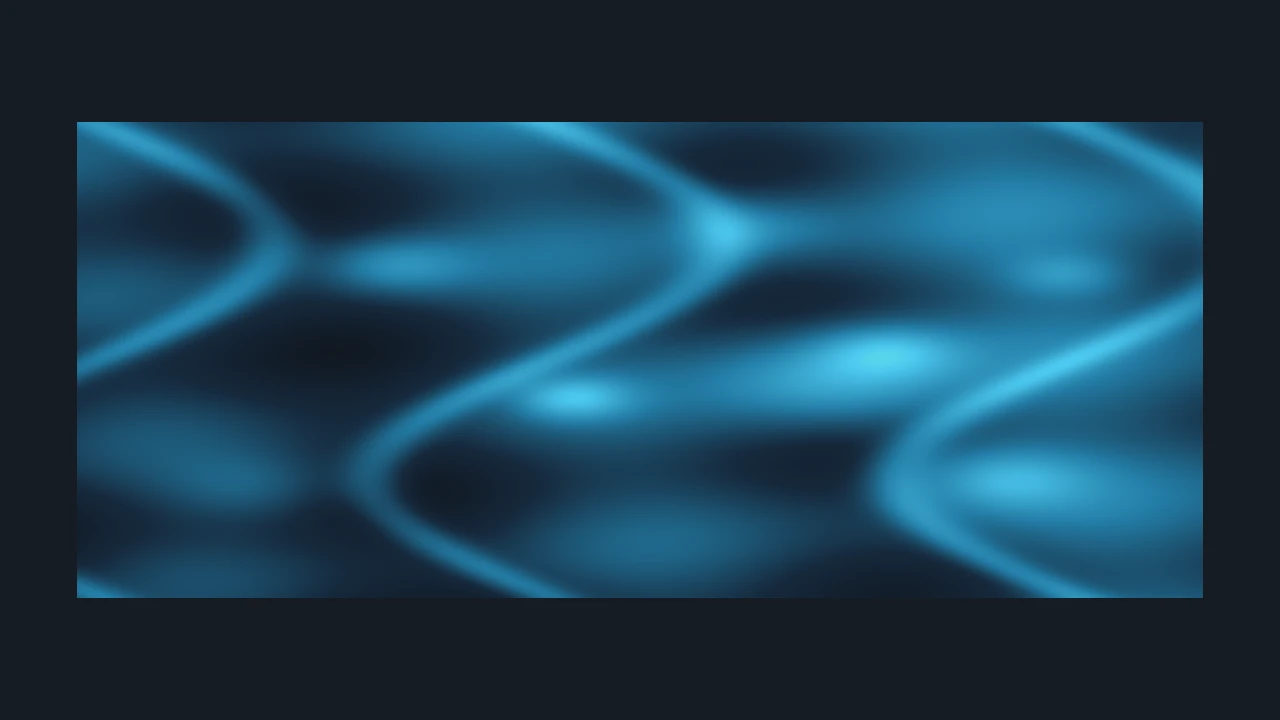
This example displays a generated scalar field as a 2D image.
Preview
Run And Adapt
Commands below assume a Datoviz source checkout and start at the repository root. Use your configured build environment; Python routes additionally require local bindings.
| Route | Availability | Command or action |
|---|---|---|
| C | Canonical native source | just example-c visuals/image (build and run), or rerun ./build/examples/c/visuals/image |
| Python | Available; manually maintained direct-engine example | python3 -m examples.python.gallery.visuals.image |
| Browser | Live WebGPU route | Open live example |
This example is approved as a starting point for user code and coding agents. Keep the object lifetimes and data shapes intact while adapting the data and styling.
What To Look For
The FIELD_WIDTH by FIELD_HEIGHT value array is attached as a sampled field, while four corner positions and texture coordinates place it on a panel. The colormap scale maps values from 0 to 1, so compare the smooth bands and local extrema in the image to see how dense measurements such as microscopy tiles, detector frames, or model grids become a texture-backed visual.
Source
#!/usr/bin/env python3
"""Generated scalar field displayed as a sampled-field image."""

from __future__ import annotations

import numpy as np

import datoviz as dvz

from examples.python.gallery import common as ex


def main() -> None:
    scene, figure, panel = ex.scene_panel()

    width, height = 320, 240
    x = np.linspace(0.0, 1.0, width, dtype=np.float32)
    y = np.linspace(0.0, 1.0, height, dtype=np.float32)
    u, v = np.meshgrid(x, y)
    field_values = (
        0.18
        + 0.22 * u
        + 0.16 * v
        + 0.12 * np.sin(2.0 * np.pi * (2.4 * u + 0.35 * v))
        + 0.10 * np.cos(2.0 * np.pi * (0.70 * u - 3.2 * v))
    ).astype(np.float32)
    field_values = np.clip(field_values, 0.0, 1.0)

    scale = ex.continuous_scale(scene, b"python_visual_image")
    field = dvz.dvz_sampled_field_from_array(scene, field_values)
    ex.add_image(scene, panel, field, scale=scale)

    ex.run_with_view(
        scene,
        figure,
        "Image",
        lambda view: ex.bind_panzoom(view, scene, panel, dvz.DVZ_DIM_MASK_XY),
    )


if __name__ == "__main__":
    main()
/*
 * Copyright (c) 2021 Cyrille Rossant and contributors. All rights reserved.
 * Licensed under the MIT license. See LICENSE file in the project root for details.
 * SPDX-License-Identifier: MIT
 */

/* image - This example displays a generated scalar field as a 2D image.
 *
 * What to look for: the FIELD_WIDTH by FIELD_HEIGHT value array is attached as a sampled field,
 * while four corner positions and texture coordinates place it on a panel. The colormap scale maps
 * values from 0 to 1, so compare the smooth bands and local extrema in the image to see how dense
 * measurements such as microscopy tiles, detector frames, or model grids become a texture-backed
 * visual.
 *
 * Scenario: visuals_image
 * Style: visuals, graphite_cyan, 1280x720 window target
 *
 * Build:  just example-c visuals/image
 * Run:    ./build/examples/c/visuals/image --live
 * Smoke:  ./build/examples/c/visuals/image --png
 */


/*************************************************************************************************/
/*  Includes                                                                                     */
/*************************************************************************************************/

#include <math.h>
#include <stdbool.h>
#include <stdint.h>

#include "_alloc.h"
#include "_assertions.h"
#include "datoviz/scene.h"
#include "example_style.h"
#include "runner/scenario_runner.h"


/*************************************************************************************************/
/*  Constants                                                                                    */
/*************************************************************************************************/

#define WIDTH  EXAMPLE_WINDOW_WIDTH
#define HEIGHT EXAMPLE_WINDOW_HEIGHT
#define FIELD_WIDTH  320u
#define FIELD_HEIGHT 240u

static const float TAU = 6.28318530718f;


/*************************************************************************************************/
/*  Forward declarations                                                                         */
/*************************************************************************************************/

DvzScenarioSpec dvz_visual_image_scenario(void);


/*************************************************************************************************/
/*  Structs                                                                                      */
/*************************************************************************************************/

typedef struct ImageVisualState
{
    float* values;
} ImageVisualState;


/*************************************************************************************************/
/*  Helpers                                                                                      */
/*************************************************************************************************/

/**
 * Clamp a scalar to the unit interval.
 *
 * @param value input value
 * @return clamped value
 */
static float _clamp01(float value)
{
    if (value < 0.0f)
        return 0.0f;
    if (value > 1.0f)
        return 1.0f;
    return value;
}


/**
 * Return a deterministic sampled-field value.
 *
 * @param x normalized X coordinate
 * @param y normalized Y coordinate
 * @return normalized scalar sample
 */
static float _sample_field(float x, float y)
{
    float value = 0.12f;
    value += 0.15f * x + 0.08f * y;
    value += 0.08f * sinf(TAU * (2.4f * x + 0.35f * y));
    value += 0.06f * cosf(TAU * (0.70f * x - 3.2f * y));

    const float ridge = sinf(TAU * (1.15f * x + 0.18f * sinf(TAU * y)));
    value += 0.21f * expf(-20.0f * (ridge - 0.12f) * (ridge - 0.12f));

    const float centers[7][3] = {
        {0.16f, 0.23f, 0.060f}, {0.28f, 0.70f, 0.047f}, {0.44f, 0.42f, 0.036f},
        {0.60f, 0.78f, 0.052f}, {0.72f, 0.52f, 0.043f}, {0.82f, 0.25f, 0.055f},
        {0.88f, 0.68f, 0.038f},
    };
    for (uint32_t i = 0; i < 7u; i++)
    {
        const float dx = x - centers[i][0];
        const float dy = y - centers[i][1];
        const float sigma = centers[i][2];
        const float d2 = (dx * dx + 1.25f * dy * dy) / (2.0f * sigma * sigma);
        value += (0.18f + 0.05f * (float)(i % 3u)) * expf(-d2);
    }

    const float marker_x = x - 0.67f;
    const float marker_y = y - 0.46f;
    value += 0.30f * expf(-(marker_x * marker_x + marker_y * marker_y) / (2.0f * 0.075f * 0.075f));

    return _clamp01(value);
}


/**
 * Fill the scalar sampled field.
 *
 * @param values output normalized scalar field
 */
static void _fill_field(float* values)
{
    ANN(values);

    for (uint32_t y = 0; y < FIELD_HEIGHT; y++)
    {
        for (uint32_t x = 0; x < FIELD_WIDTH; x++)
        {
            const float u = FIELD_WIDTH > 1u ? (float)x / (float)(FIELD_WIDTH - 1u) : 0.0f;
            const float v = FIELD_HEIGHT > 1u ? (float)y / (float)(FIELD_HEIGHT - 1u) : 0.0f;
            values[y * FIELD_WIDTH + x] = _sample_field(u, v);
        }
    }
}


/**
 * Create the graphite/cyan/amber scalar image scale.
 *
 * @param scene scene owning the scale
 * @return created scale, or NULL on failure
 */
static DvzScale* _add_image_scale(DvzScene* scene)
{
    ANN(scene);

    DvzScale* scale = dvz_scale(
        scene,
        &(DvzScaleDesc){DVZ_STRUCT_INIT_FIELDS(DvzScaleDesc), .kind = DVZ_SCALE_CONTINUOUS});
    if (scale == NULL)
        return NULL;
    dvz_scale_set_domain(scale, 0.0, 1.0);

    DvzColormap* colormap = dvz_colormap(scene, NULL);
    if (colormap == NULL)
        return NULL;

    DvzColormapStop stops[6] = {
        {.position = 0.00, .rgba = {14, 17, 23, 255}},
        {.position = 0.18, .rgba = {22, 42, 62, 255}},
        {.position = 0.40, .rgba = {35, 124, 165, 255}},
        {.position = 0.64, .rgba = {76, 201, 240, 255}},
        {.position = 0.84, .rgba = {128, 255, 219, 255}},
        {.position = 1.00, .rgba = {255, 183, 3, 255}},
    };
    dvz_colormap_set_stops(colormap, stops, 6);
    dvz_scale_set_colormap(scale, colormap);
    return scale;
}


/**
 * Add the sampled-field image visual to the panel.
 *
 * @param scene scene owning the visual and field
 * @param panel panel receiving the image
 * @param scale scalar color scale
 * @param values scalar field values
 * @return true when the image was added
 */
static bool _add_image(DvzScene* scene, DvzPanel* panel, DvzScale* scale, float* values)
{
    ANN(scene);
    ANN(panel);
    ANN(scale);
    ANN(values);

    vec3 positions[4] = {
        {-0.88f, -0.66f, 0.0f},
        {-0.88f, +0.66f, 0.0f},
        {+0.88f, -0.66f, 0.0f},
        {+0.88f, +0.66f, 0.0f},
    };
    vec2 texcoords[4] = {
        {0.0f, 0.0f},
        {0.0f, 1.0f},
        {1.0f, 0.0f},
        {1.0f, 1.0f},
    };

    DvzVisual* image = dvz_image(scene, 0);
    if (image == NULL)
        return false;
    if (dvz_visual_set_data(image, "position", positions, 4) != 0)
        return false;
    if (dvz_visual_set_data(image, "texcoords", texcoords, 4) != 0)
        return false;
    if (dvz_visual_set_scale(image, "color", scale) != 0)
        return false;

    DvzSampledField* field = dvz_sampled_field(
        scene, &(DvzSampledFieldDesc){
                   DVZ_STRUCT_INIT_FIELDS(DvzSampledFieldDesc),
                   .dim = DVZ_FIELD_DIM_2D,
                   .format = DVZ_FIELD_FORMAT_R32_FLOAT,
                   .semantic = DVZ_FIELD_SEMANTIC_SCALAR,
                   .width = FIELD_WIDTH,
                   .height = FIELD_HEIGHT,
                   .depth = 1,
               });
    if (field == NULL)
        return false;
    if (dvz_sampled_field_set_data(
            field, &(DvzFieldDataView){
                       DVZ_STRUCT_INIT_FIELDS(DvzFieldDataView),
                       .data = values,
                       .bytes_per_row = FIELD_WIDTH * sizeof(float),
                       .rows_per_image = FIELD_HEIGHT,
                   }) != DVZ_OK)
    {
        return false;
    }
    if (dvz_visual_set_field(image, "field", field) != DVZ_OK)
        return false;
    if (dvz_visual_set_depth_test(image, false) != 0)
        return false;
    return dvz_panel_add_visual(panel, image, NULL) == 0;
}


/*************************************************************************************************/
/*  Scenario callbacks                                                                           */
/*************************************************************************************************/

/**
 * Initialize the retained image visual scenario.
 *
 * @param ctx scenario context
 * @param out_user scenario state output
 * @return true on success
 */
static bool _scenario_init(DvzScenarioContext* ctx, void** out_user)
{
    if (ctx == NULL)
        return false;
    if (out_user != NULL)
        *out_user = NULL;

    ImageVisualState* state = (ImageVisualState*)dvz_malloc(sizeof(*state));
    if (state == NULL)
        return false;
    state->values = NULL;

    state->values = (float*)dvz_malloc(FIELD_WIDTH * FIELD_HEIGHT * sizeof(*state->values));
    if (state->values == NULL)
    {
        dvz_free(state);
        return false;
    }
    _fill_field(state->values);

    ctx->figure = dvz_figure(ctx->scene, ctx->width, ctx->height, 0);
    if (ctx->figure == NULL)
        goto error;

    DvzPanel* panel = dvz_panel_full(ctx->figure);
    if (panel == NULL)
        goto error;
    example_graphite_cyan_set_panel_background(panel);

    DvzScale* scale = _add_image_scale(ctx->scene);
    if (scale == NULL)
        goto error;

    if (!_add_image(ctx->scene, panel, scale, state->values))
        goto error;
    if (dvz_scenario_panzoom(ctx, panel, NULL, DVZ_DIM_MASK_XY) == NULL)
        goto error;

    if (out_user != NULL)
        *out_user = state;
    return true;

error:
    dvz_free(state->values);
    dvz_free(state);
    return false;
}


/**
 * Destroy the retained image visual scenario state.
 *
 * @param ctx scenario context
 * @param user scenario state
 */
static void _scenario_destroy(DvzScenarioContext* ctx, void* user)
{
    (void)ctx;

    ImageVisualState* state = (ImageVisualState*)user;
    if (state == NULL)
        return;
    dvz_free(state->values);
    dvz_free(state);
}


/**
 * Return the image visual scenario specification.
 *
 * @return scenario specification
 */
DvzScenarioSpec dvz_visual_image_scenario(void)
{
    return (DvzScenarioSpec){
        .id = "visuals_image",
        .title = "Image",
        .width = WIDTH,
        .height = HEIGHT,
        .fps = 60.0,
        .init = _scenario_init,
        .destroy = _scenario_destroy,
    };
}


/*************************************************************************************************/
/*  Functions                                                                                    */
/*************************************************************************************************/

/**
 * Run the retained image visual example through the native scenario runner.
 *
 * @param argc command-line argument count
 * @param argv command-line argument vector
 * @return process exit code
 */
#ifndef DVZ_EXAMPLE_NO_MAIN
int main(int argc, char** argv)
{
    DvzScenarioSpec spec = dvz_visual_image_scenario();
    return dvz_scenario_run_native_cli(&spec, argc, argv) == 0 ? 0 : 1;
}
#endif
Example details
- ID:
visuals_image - Category:
visual - Lane:
visuals - Status:
supported - Source:
examples/c/visuals/image.c - Approved adaptation starter:
yes - Reference: Image visual family
- Python source:
examples/python/gallery/visuals/image.py - Python adaptation: Available; manually maintained direct-engine example
- Browser support: Live in browser
- WebGPU live route:
examples/webgpu/live.html?id=visuals_image - Browser capability tags:
image,sampled-field,panzoom - Validation:
smoke+screenshot
Tags
image, sampled-field, panzoom, capture
Data
| Field | Value |
|---|---|
kind |
synthetic |