Spherical Harmonics
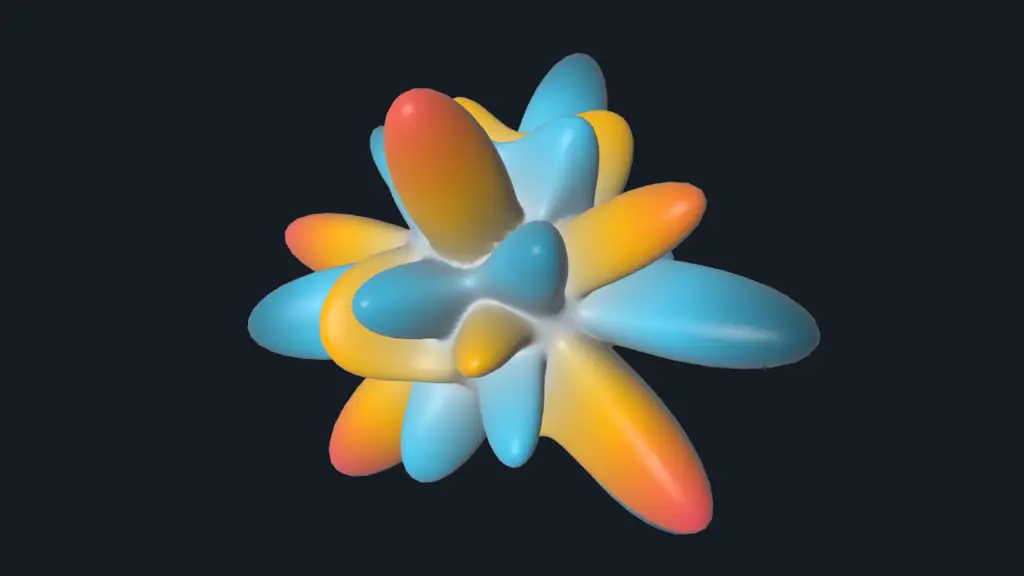
This example turns a real spherical-harmonic blend into a lit mesh.
Preview
Run And Adapt
Commands below assume a Datoviz source checkout and start at the repository root. Use your configured build environment; Python routes additionally require local bindings.
| Route | Availability | Command or action |
|---|---|---|
| C | Canonical native source | just example-c showcases/spherical_harmonics (build and run), or rerun ./build/examples/c/showcases/spherical_harmonics |
| Python | Available | python3 -m examples.python.gallery.showcases.spherical_harmonics |
| Browser | Live WebGPU route | Open live example |
Use this example as capability or integration evidence, not as a minimal copy-paste template. Start from the nearest supported, copy-safe example and add this feature after verifying the linked API reference.
What To Look For
A uniformly tessellated icosphere is deformed radially by a deterministic blend of real spherical harmonics. The coefficients morph in a slow seamless loop, vertex color preserves the signed amplitude, and smooth normals reveal the changing folded surface.
This workflow is useful for directional basis functions, radiation patterns, orbital-like surfaces, and other spherical scalar fields that benefit from direct 3D shape perception. Native live mode adds controls for the surface mapping and every harmonic term.
Source
#!/usr/bin/env python3
"""Vectorized real spherical-harmonic deformation of an indexed icosphere."""

from __future__ import annotations

import ctypes
import math

import numpy as np

import datoviz as dvz
from examples.python.gallery import common as ex


SUBDIVISIONS = 4
MORPH_PERIOD = 8.0
TERMS = np.array(
    [
        (7, +3, +1.00, 0.22, 1.0),
        (6, -5, +0.58, 0.25, 2.0),
        (5, +2, -0.38, 0.20, 3.0),
        (4, -1, +0.25, 0.18, 1.0),
    ],
    dtype=[("degree", "i4"), ("order", "i4"), ("base", "f8"), ("morph", "f8"), ("frequency", "f8")],
)
PALETTE = np.array(
    [[18, 47, 57], [34, 211, 238], [217, 226, 236], [250, 183, 3], [239, 71, 111]],
    dtype=np.float64,
)
INITIAL_ANGLES = (ctypes.c_float * 3)(-0.233247, +0.292663, -0.038705)


def _icosphere(subdivisions: int) -> tuple[np.ndarray, np.ndarray]:
    phi = (1.0 + np.sqrt(5.0)) / 2.0
    vertices = np.array(
        [
            [-1, +phi, 0], [+1, +phi, 0], [-1, -phi, 0], [+1, -phi, 0],
            [0, -1, +phi], [0, +1, +phi], [0, -1, -phi], [0, +1, -phi],
            [+phi, 0, -1], [+phi, 0, +1], [-phi, 0, -1], [-phi, 0, +1],
        ],
        dtype=np.float64,
    )
    vertices /= np.linalg.norm(vertices, axis=1, keepdims=True)
    faces = np.array(
        [
            [0, 11, 5], [0, 5, 1], [0, 1, 7], [0, 7, 10], [0, 10, 11],
            [1, 5, 9], [5, 11, 4], [11, 10, 2], [10, 7, 6], [7, 1, 8],
            [3, 9, 4], [3, 4, 2], [3, 2, 6], [3, 6, 8], [3, 8, 9],
            [4, 9, 5], [2, 4, 11], [6, 2, 10], [8, 6, 7], [9, 8, 1],
        ],
        dtype=np.uint32,
    )
    for _ in range(subdivisions):
        edge_cache: dict[tuple[int, int], int] = {}
        next_vertices = vertices.tolist()

        def midpoint(a: int, b: int) -> int:
            key = (min(a, b), max(a, b))
            if key not in edge_cache:
                value = vertices[a] + vertices[b]
                value /= np.linalg.norm(value)
                edge_cache[key] = len(next_vertices)
                next_vertices.append(value.tolist())
            return edge_cache[key]

        next_faces = []
        for a, b, c in faces:
            ab, bc, ca = midpoint(int(a), int(b)), midpoint(int(b), int(c)), midpoint(int(c), int(a))
            next_faces.extend(((a, ab, ca), (b, bc, ab), (c, ca, bc), (ab, bc, ca)))
        vertices = np.asarray(next_vertices, dtype=np.float64)
        faces = np.asarray(next_faces, dtype=np.uint32)
    return vertices, faces


def _associated_legendre(degree: int, order: int, x: np.ndarray) -> np.ndarray:
    p_mm = np.ones_like(x)
    if order:
        root = np.sqrt(np.maximum(0.0, 1.0 - x * x))
        for factor in range(1, 2 * order, 2):
            p_mm *= -factor * root
    if degree == order:
        return p_mm
    previous = x * (2 * order + 1) * p_mm
    if degree == order + 1:
        return previous
    previous2 = p_mm
    for level in range(order + 2, degree + 1):
        current = ((2 * level - 1) * x * previous - (level + order - 1) * previous2) / (level - order)
        previous2, previous = previous, current
    return previous


def _basis(directions: np.ndarray) -> np.ndarray:
    cos_theta = np.clip(directions[:, 2], -1.0, 1.0)
    azimuth = np.arctan2(directions[:, 1], directions[:, 0])
    columns = []
    for term in TERMS:
        degree, order = int(term["degree"]), int(term["order"])
        absolute_order = abs(order)
        normalization = np.sqrt(
            (2 * degree + 1) / (4 * np.pi)
            * np.exp(math.lgamma(degree - absolute_order + 1) - math.lgamma(degree + absolute_order + 1))
        )
        values = normalization * _associated_legendre(degree, absolute_order, cos_theta)
        if order > 0:
            values *= np.sqrt(2.0) * np.cos(absolute_order * azimuth)
        elif order < 0:
            values *= np.sqrt(2.0) * np.sin(absolute_order * azimuth)
        columns.append(values)
    return np.column_stack(columns)


def _colors(amplitude: np.ndarray) -> np.ndarray:
    coordinate = 2.0 * np.clip(amplitude + 1.0, 0.0, 2.0)
    segment = np.minimum(coordinate.astype(np.int32), 3)
    local = (coordinate - segment)[:, None]
    rgb = (1.0 - local) * PALETTE[segment] + local * PALETTE[segment + 1]
    return np.column_stack((np.clip(rgb + 0.5, 0, 255).astype(np.uint8), np.full(len(rgb), 255, np.uint8)))


def _geometry(directions: np.ndarray, faces: np.ndarray, basis: np.ndarray, phase: float):
    weights = TERMS["base"] + TERMS["morph"] * np.sin(2.0 * np.pi * TERMS["frequency"] * phase)
    amplitude = basis @ weights
    amplitude /= max(float(np.max(np.abs(amplitude))), 1e-12)
    smooth = (np.sqrt(amplitude * amplitude + 0.18**2) - 0.18) / (np.sqrt(1.0 + 0.18**2) - 0.18)
    breathing = 0.96 + 0.04 * np.cos(2.0 * np.pi * phase)
    positions = directions * (0.54 + 0.94 * breathing * smooth)[:, None]

    triangles = positions[faces]
    face_normals = np.cross(triangles[:, 1] - triangles[:, 0], triangles[:, 2] - triangles[:, 0])
    normals = np.zeros_like(positions)
    np.add.at(normals, faces[:, 0], face_normals)
    np.add.at(normals, faces[:, 1], face_normals)
    np.add.at(normals, faces[:, 2], face_normals)
    normals /= np.maximum(np.linalg.norm(normals, axis=1, keepdims=True), 1e-12)
    return positions.astype(np.float32), normals.astype(np.float32), _colors(amplitude)


def _build_scene():
    directions, faces = _icosphere(SUBDIVISIONS)
    basis = _basis(directions)
    positions, normals, colors = _geometry(directions, faces, basis, 0.0)
    scene, figure, panel = ex.scene_panel()

    camera = dvz.dvz_camera_desc()
    camera.view.eye[:] = (-0.46, +2.20, +3.42)
    camera.view.target[:] = (0.0, 0.0, 0.0)
    camera.view.up[:] = (0.0, 1.0, 0.0)
    camera.projection.fov_y = 0.58
    camera.projection.near_clip = 0.05
    camera.projection.far_clip = 100.0
    if dvz.dvz_panel_set_camera_desc(panel, ctypes.byref(camera)) != 0:
        raise RuntimeError("dvz_panel_set_camera_desc() failed")

    mesh = dvz.dvz_mesh(scene, 0)
    if not mesh:
        raise RuntimeError("dvz_mesh() failed")
    if dvz.dvz_visual_set_data_many(mesh, {"position": positions, "normal": normals, "color": colors}) != 0:
        raise RuntimeError("dvz_visual_set_data_many(mesh) failed")
    if dvz.dvz_visual_set_index_data(mesh, faces.reshape(-1)) != 0:
        raise RuntimeError("dvz_visual_set_index_data() failed")
    material = dvz.dvz_standard_material_desc()
    material.light_direction[:] = (-0.48, +0.62, +0.72)
    material.standard.roughness = 0.58
    material.standard.specular = 0.16
    material.standard.rim_strength = 0.12
    if dvz.dvz_visual_set_material(mesh, ctypes.byref(material)) != 0:
        raise RuntimeError("dvz_visual_set_material() failed")
    ex.add_visual(panel, mesh)
    return scene, figure, panel, mesh, directions, faces, basis


def main() -> None:
    scene, figure, panel, mesh, directions, faces, basis = _build_scene()

    def configure(view) -> None:
        arcball = dvz.dvz_view_arcball(view, panel, None)
        if not arcball or dvz.dvz_arcball_set(arcball, INITIAL_ANGLES) != 0:
            raise RuntimeError("arcball setup failed")
        dvz.dvz_arcball_zoom(arcball, 0.606531)

    def on_frame(_view, _frame_index: int, elapsed: float) -> None:
        positions, normals, colors = _geometry(directions, faces, basis, (elapsed / MORPH_PERIOD) % 1.0)
        if dvz.dvz_visual_set_data_many(mesh, {"position": positions, "normal": normals, "color": colors}) != 0:
            raise RuntimeError("spherical-harmonics update failed")

    ex.run_with_frame_callback(scene, figure, "Spherical Harmonics", on_frame, configure)


if __name__ == "__main__":
    main()
/*
* Copyright (c) 2021 Cyrille Rossant and contributors. All rights reserved.
* Licensed under the MIT license. See LICENSE file in the project root for details.
* SPDX-License-Identifier: MIT
*/
/* spherical_harmonics - This example turns a real spherical-harmonic blend into a lit mesh.
*
* What to look for: a uniformly tessellated icosphere is deformed radially by a deterministic
* blend of real spherical harmonics. The coefficients morph in a slow seamless loop, vertex color
* preserves the signed amplitude, and smooth normals reveal the changing folded surface.
*
* This workflow is useful for directional basis functions, radiation patterns, orbital-like
* surfaces, and other spherical scalar fields that benefit from direct 3D shape perception.
* Native live mode adds controls for the surface mapping and every harmonic term.
*
* Scenario: showcases_spherical_harmonics
* Style: showcase, graphite_cyan, 1280x720 window target
*
* Build: just example-c showcases/spherical_harmonics
* Run: ./build/examples/c/showcases/spherical_harmonics --live
* Smoke: ./build/examples/c/showcases/spherical_harmonics --png
*/
/*************************************************************************************************/
/* Includes */
/*************************************************************************************************/
#include <math.h>
#include <stdbool.h>
#include <stdint.h>
#include <stdlib.h>
#include "_alloc.h"
#include "datoviz/geom.h"
#include "datoviz/scene.h"
#include "example_common.h"
#include "example_style.h"
#include "example_tuner.h"
#include "runner/scenario_runner.h"
/*************************************************************************************************/
/* Constants */
/*************************************************************************************************/
#define WIDTH EXAMPLE_WINDOW_WIDTH
#define HEIGHT EXAMPLE_WINDOW_HEIGHT
#define ICOSPHERE_SUBDIVISIONS 5u
#define HARMONIC_TERM_COUNT 4u
#define HARMONIC_MORPH_PERIOD 8.0
#define PI 3.14159265358979323846
/*************************************************************************************************/
/* Structs */
/*************************************************************************************************/
typedef struct HarmonicTerm
{
int degree;
int order;
float base_weight;
float morph_amplitude;
int morph_frequency;
float morph_phase;
} HarmonicTerm;
typedef struct HarmonicSettings
{
bool animate;
float phase;
float speed;
float base_radius;
float lobe_scale;
float lobe_power;
float node_smoothing;
float breathing_amplitude;
HarmonicTerm terms[HARMONIC_TERM_COUNT];
} HarmonicSettings;
typedef struct MeshBuffers
{
dvec3* positions;
DvzIndex* indices;
uint32_t vertex_count;
uint32_t index_count;
} MeshBuffers;
typedef struct EdgeEntry
{
uint64_t key;
DvzIndex midpoint;
bool used;
} EdgeEntry;
typedef struct SphericalHarmonicsState
{
ExampleTuner tuner;
DvzGeometry* geometry;
DvzVisual* visual;
DvzArcball* arcball;
DvzMaterialDesc material;
HarmonicSettings settings;
HarmonicSettings defaults;
dvec3* directions;
double* basis;
double* amplitudes;
vec3* gpu_positions;
vec3* gpu_normals;
double last_time;
bool time_initialized;
bool basis_dirty;
bool geometry_dirty;
int preset_index;
int basis_degree[HARMONIC_TERM_COUNT];
int basis_order[HARMONIC_TERM_COUNT];
} SphericalHarmonicsState;
/*************************************************************************************************/
/* Constants */
/*************************************************************************************************/
static const HarmonicSettings HARMONIC_DEFAULTS = {
.animate = true,
.phase = 0.0f,
.speed = 1.0f,
.base_radius = 0.54f,
.lobe_scale = 0.94f,
.lobe_power = 1.00f,
.node_smoothing = 0.18f,
.breathing_amplitude = 0.04f,
.terms =
{
{.degree = 7,
.order = +3,
.base_weight = +1.00f,
.morph_amplitude = 0.22f,
.morph_frequency = 1,
.morph_phase = 0.00f},
{.degree = 6,
.order = -5,
.base_weight = +0.58f,
.morph_amplitude = 0.25f,
.morph_frequency = 2,
.morph_phase = 0.00f},
{.degree = 5,
.order = +2,
.base_weight = -0.38f,
.morph_amplitude = 0.20f,
.morph_frequency = 3,
.morph_phase = 0.00f},
{.degree = 4,
.order = -1,
.base_weight = +0.25f,
.morph_amplitude = 0.18f,
.morph_frequency = 1,
.morph_phase = 0.00f},
},
};
/*************************************************************************************************/
/* Forward declarations */
/*************************************************************************************************/
DvzScenarioSpec dvz_showcase_spherical_harmonics_scenario(void);
/*************************************************************************************************/
/* Helpers */
/*************************************************************************************************/
/**
* Release temporary mesh arrays and reset their counts.
*
* @param mesh mesh arrays to release
*/
static void _mesh_buffers_reset(MeshBuffers* mesh)
{
if (mesh == NULL)
return;
dvz_free(mesh->positions);
dvz_free(mesh->indices);
mesh->positions = NULL;
mesh->indices = NULL;
mesh->vertex_count = 0;
mesh->index_count = 0;
}
/**
* Normalize one double-precision vector in place.
*
* @param v vector to normalize
* @return whether the vector had a finite non-zero norm
*/
static bool _normalize(dvec3 v)
{
const double norm = sqrt(v[0] * v[0] + v[1] * v[1] + v[2] * v[2]);
if (!(norm > 0.0) || !isfinite(norm))
return false;
v[0] /= norm;
v[1] /= norm;
v[2] /= norm;
return true;
}
/**
* Return the next power of two greater than or equal to a value.
*
* @param value positive input value
* @return power-of-two capacity, or zero on overflow
*/
static uint32_t _next_power_of_two(uint32_t value)
{
if (value == 0)
return 1;
value--;
value |= value >> 1u;
value |= value >> 2u;
value |= value >> 4u;
value |= value >> 8u;
value |= value >> 16u;
value++;
return value;
}
/**
* Return a stable undirected edge key for two vertex indices.
*
* @param a first vertex index
* @param b second vertex index
* @return packed edge key
*/
static uint64_t _edge_key(DvzIndex a, DvzIndex b)
{
const uint32_t lo = a < b ? a : b;
const uint32_t hi = a < b ? b : a;
return ((uint64_t)lo << 32u) | (uint64_t)hi;
}
/**
* Find or create the normalized midpoint shared by one mesh edge.
*
* @param positions mutable vertex array
* @param vertex_count mutable number of populated vertices
* @param vertex_capacity allocated vertex capacity
* @param cache edge midpoint cache
* @param cache_capacity power-of-two cache capacity
* @param a first edge endpoint
* @param b second edge endpoint
* @param out output midpoint vertex index
* @return whether the midpoint was found or created
*/
static bool _edge_midpoint(
dvec3* positions, uint32_t* vertex_count, uint32_t vertex_capacity, EdgeEntry* cache,
uint32_t cache_capacity, DvzIndex a, DvzIndex b, DvzIndex* out)
{
if (positions == NULL || vertex_count == NULL || cache == NULL || cache_capacity == 0 ||
out == NULL || a >= *vertex_count || b >= *vertex_count)
{
return false;
}
const uint64_t key = _edge_key(a, b);
uint32_t slot = (uint32_t)((key * UINT64_C(11400714819323198485)) & (cache_capacity - 1u));
while (cache[slot].used)
{
if (cache[slot].key == key)
{
*out = cache[slot].midpoint;
return true;
}
slot = (slot + 1u) & (cache_capacity - 1u);
}
if (*vertex_count >= vertex_capacity)
return false;
const uint32_t midpoint = *vertex_count;
positions[midpoint][0] = 0.5 * (positions[a][0] + positions[b][0]);
positions[midpoint][1] = 0.5 * (positions[a][1] + positions[b][1]);
positions[midpoint][2] = 0.5 * (positions[a][2] + positions[b][2]);
if (!_normalize(positions[midpoint]))
return false;
*vertex_count = midpoint + 1u;
cache[slot].used = true;
cache[slot].key = key;
cache[slot].midpoint = midpoint;
*out = midpoint;
return true;
}
/**
* Initialize a unit icosahedron with shared vertices.
*
* @param out output mesh arrays
* @return whether allocation and initialization succeeded
*/
static bool _icosahedron(MeshBuffers* out)
{
if (out == NULL)
return false;
static const double vertices[12][3] = {
{-1.0, +1.618033988749895, 0.0}, {+1.0, +1.618033988749895, 0.0},
{-1.0, -1.618033988749895, 0.0}, {+1.0, -1.618033988749895, 0.0},
{0.0, -1.0, +1.618033988749895}, {0.0, +1.0, +1.618033988749895},
{0.0, -1.0, -1.618033988749895}, {0.0, +1.0, -1.618033988749895},
{+1.618033988749895, 0.0, -1.0}, {+1.618033988749895, 0.0, +1.0},
{-1.618033988749895, 0.0, -1.0}, {-1.618033988749895, 0.0, +1.0},
};
static const DvzIndex faces[60] = {
0, 11, 5, 0, 5, 1, 0, 1, 7, 0, 7, 10, 0, 10, 11, 1, 5, 9, 5, 11,
4, 11, 10, 2, 10, 7, 6, 7, 1, 8, 3, 9, 4, 3, 4, 2, 3, 2, 6, 3,
6, 8, 3, 8, 9, 4, 9, 5, 2, 4, 11, 6, 2, 10, 8, 6, 7, 9, 8, 1,
};
out->positions = (dvec3*)dvz_calloc(12u, sizeof(dvec3));
out->indices = (DvzIndex*)dvz_calloc(60u, sizeof(DvzIndex));
if (out->positions == NULL || out->indices == NULL)
{
_mesh_buffers_reset(out);
return false;
}
out->vertex_count = 12u;
out->index_count = 60u;
for (uint32_t i = 0; i < out->vertex_count; i++)
{
out->positions[i][0] = vertices[i][0];
out->positions[i][1] = vertices[i][1];
out->positions[i][2] = vertices[i][2];
if (!_normalize(out->positions[i]))
{
_mesh_buffers_reset(out);
return false;
}
}
(void)dvz_memcpy(out->indices, 60u * sizeof(DvzIndex), faces, sizeof(faces));
return true;
}
/**
* Subdivide every triangle into four triangles while sharing edge midpoints.
*
* @param mesh input and output mesh arrays
* @return whether subdivision succeeded
*/
static bool _subdivide(MeshBuffers* mesh)
{
if (mesh == NULL || mesh->positions == NULL || mesh->indices == NULL ||
mesh->index_count == 0 || mesh->index_count % 3u != 0)
{
return false;
}
const uint32_t face_count = mesh->index_count / 3u;
if (face_count > UINT32_MAX / 12u || mesh->vertex_count > UINT32_MAX - 3u * face_count)
return false;
const uint32_t vertex_capacity = mesh->vertex_count + 3u * face_count;
const uint32_t next_index_count = mesh->index_count * 4u;
const uint32_t cache_capacity = _next_power_of_two(4u * face_count);
if (cache_capacity == 0)
return false;
MeshBuffers next = {0};
next.positions = (dvec3*)dvz_calloc(vertex_capacity, sizeof(dvec3));
next.indices = (DvzIndex*)dvz_calloc(next_index_count, sizeof(DvzIndex));
EdgeEntry* cache = (EdgeEntry*)dvz_calloc(cache_capacity, sizeof(EdgeEntry));
if (next.positions == NULL || next.indices == NULL || cache == NULL)
goto error;
const size_t position_bytes = (size_t)mesh->vertex_count * sizeof(dvec3);
(void)dvz_memcpy(
next.positions, (size_t)vertex_capacity * sizeof(dvec3), mesh->positions, position_bytes);
next.vertex_count = mesh->vertex_count;
next.index_count = next_index_count;
for (uint32_t face = 0; face < face_count; face++)
{
const DvzIndex a = mesh->indices[3u * face + 0u];
const DvzIndex b = mesh->indices[3u * face + 1u];
const DvzIndex c = mesh->indices[3u * face + 2u];
DvzIndex ab = 0, bc = 0, ca = 0;
if (!_edge_midpoint(
next.positions, &next.vertex_count, vertex_capacity, cache, cache_capacity, a, b,
&ab) ||
!_edge_midpoint(
next.positions, &next.vertex_count, vertex_capacity, cache, cache_capacity, b, c,
&bc) ||
!_edge_midpoint(
next.positions, &next.vertex_count, vertex_capacity, cache, cache_capacity, c, a,
&ca))
{
goto error;
}
const uint32_t i = 12u * face;
next.indices[i + 0u] = a;
next.indices[i + 1u] = ab;
next.indices[i + 2u] = ca;
next.indices[i + 3u] = b;
next.indices[i + 4u] = bc;
next.indices[i + 5u] = ab;
next.indices[i + 6u] = c;
next.indices[i + 7u] = ca;
next.indices[i + 8u] = bc;
next.indices[i + 9u] = ab;
next.indices[i + 10u] = bc;
next.indices[i + 11u] = ca;
}
dvz_free(cache);
_mesh_buffers_reset(mesh);
*mesh = next;
return true;
error:
dvz_free(cache);
_mesh_buffers_reset(&next);
return false;
}
/**
* Evaluate the associated Legendre polynomial P_l^m at x.
*
* @param degree polynomial degree
* @param order non-negative polynomial order
* @param x input coordinate in [-1, +1]
* @return associated Legendre value
*/
static double _associated_legendre(uint32_t degree, uint32_t order, double x)
{
if (order > degree)
return 0.0;
double p_mm = 1.0;
if (order > 0)
{
const double root = sqrt(fmax(0.0, 1.0 - x * x));
double factor = 1.0;
for (uint32_t i = 1; i <= order; i++)
{
p_mm *= -factor * root;
factor += 2.0;
}
}
if (degree == order)
return p_mm;
double p_lm_prev = x * (2.0 * (double)order + 1.0) * p_mm;
if (degree == order + 1u)
return p_lm_prev;
double p_lm_prev2 = p_mm;
for (uint32_t l = order + 2u; l <= degree; l++)
{
const double p_lm = ((2.0 * (double)l - 1.0) * x * p_lm_prev -
((double)l + (double)order - 1.0) * p_lm_prev2) /
((double)l - (double)order);
p_lm_prev2 = p_lm_prev;
p_lm_prev = p_lm;
}
return p_lm_prev;
}
/**
* Evaluate one orthonormal real spherical harmonic.
*
* @param degree harmonic degree
* @param order signed harmonic order
* @param cos_theta cosine of the polar angle
* @param phi azimuthal angle in radians
* @return real spherical-harmonic value
*/
static double
_real_spherical_harmonic(uint32_t degree, int32_t order, double cos_theta, double phi)
{
const uint32_t abs_order = (uint32_t)(order < 0 ? -order : order);
if (abs_order > degree)
return 0.0;
const double log_ratio =
lgamma((double)(degree - abs_order + 1u)) - lgamma((double)(degree + abs_order + 1u));
const double normalization =
sqrt(((2.0 * (double)degree + 1.0) / (4.0 * PI)) * exp(log_ratio));
const double p = _associated_legendre(degree, abs_order, cos_theta);
if (order > 0)
return sqrt(2.0) * normalization * cos((double)abs_order * phi) * p;
if (order < 0)
return sqrt(2.0) * normalization * sin((double)abs_order * phi) * p;
return normalization * p;
}
/**
* Evaluate every harmonic basis term at one unit direction.
*
* @param direction unit sphere direction
* @param settings harmonic settings
* @param out output basis values
*/
static void _harmonic_basis(
const dvec3 direction, const HarmonicSettings* settings, double out[HARMONIC_TERM_COUNT])
{
if (settings == NULL)
return;
const double cos_theta = fmax(-1.0, fmin(+1.0, direction[2]));
const double phi = atan2(direction[1], direction[0]);
for (uint32_t term = 0; term < HARMONIC_TERM_COUNT; term++)
{
out[term] = _real_spherical_harmonic(
(uint32_t)settings->terms[term].degree, settings->terms[term].order, cos_theta, phi);
}
}
/**
* Compute the periodic harmonic coefficients for one animation phase.
*
* @param settings harmonic settings
* @param phase seamless animation phase in [0, 1)
* @param out output harmonic weights
*/
static void
_harmonic_weights(const HarmonicSettings* settings, double phase, double out[HARMONIC_TERM_COUNT])
{
if (settings == NULL)
return;
for (uint32_t term = 0; term < HARMONIC_TERM_COUNT; term++)
{
const HarmonicTerm* item = &settings->terms[term];
const double angle =
2.0 * PI * ((double)item->morph_frequency * phase + (double)item->morph_phase);
out[term] = (double)item->base_weight + (double)item->morph_amplitude * sin(angle);
}
}
/**
* Linearly interpolate between two colors.
*
* @param a first color
* @param b second color
* @param t interpolation coordinate in [0, 1]
* @return interpolated opaque color
*/
static DvzColor _mix_color(DvzColor a, DvzColor b, double t)
{
t = fmax(0.0, fmin(1.0, t));
return dvz_color_rgba(
(uint8_t)lround((1.0 - t) * (double)a.r + t * (double)b.r),
(uint8_t)lround((1.0 - t) * (double)a.g + t * (double)b.g),
(uint8_t)lround((1.0 - t) * (double)a.b + t * (double)b.b), 255u);
}
/**
* Map a normalized signed harmonic amplitude to the showcase palette.
*
* @param amplitude signed amplitude in [-1, +1]
* @return opaque vertex color
*/
static DvzColor _harmonic_color(double amplitude)
{
const DvzColor panel = example_graphite_cyan_color(EXAMPLE_STYLE_COLOR_PANEL_BG);
const DvzColor stops[5] = {
_mix_color(panel, example_graphite_cyan_color(EXAMPLE_STYLE_COLOR_ACCENT_PRIMARY), 0.28),
example_graphite_cyan_color(EXAMPLE_STYLE_COLOR_ACCENT_PRIMARY),
example_graphite_cyan_color(EXAMPLE_STYLE_COLOR_TEXT),
example_graphite_cyan_color(EXAMPLE_STYLE_COLOR_WARNING),
example_graphite_cyan_color(EXAMPLE_STYLE_COLOR_ERROR),
};
const double x = 2.0 * (0.5 * (fmax(-1.0, fmin(+1.0, amplitude)) + 1.0));
const uint32_t segment = x >= 2.0 ? 3u : (uint32_t)floor(x * 2.0);
const double local = x >= 2.0 ? 1.0 : x * 2.0 - (double)segment;
return _mix_color(stops[segment], stops[segment + 1u], local);
}
/**
* Map an absolute normalized amplitude to a smooth radial lobe coordinate.
*
* The offset smooth magnitude is zero at a harmonic node and has a finite zero slope there. This
* avoids the cusp produced by pow(abs(x), p) when p is below one.
*
* @param settings harmonic settings
* @param amplitude normalized signed amplitude in [-1, +1]
* @return smooth lobe coordinate in [0, 1]
*/
static double _smooth_lobe(const HarmonicSettings* settings, double amplitude)
{
if (settings == NULL)
return 0.0;
const double epsilon = (double)settings->node_smoothing;
const double magnitude = sqrt(amplitude * amplitude + epsilon * epsilon) - epsilon;
const double maximum = sqrt(1.0 + epsilon * epsilon) - epsilon;
return pow(fmax(0.0, magnitude / maximum), (double)settings->lobe_power);
}
/**
* Compute area-weighted vertex normals for the deformed indexed mesh.
*
* @param state initialized showcase state
* @return whether every triangle index and output normal is valid
*/
static bool _compute_area_weighted_normals(SphericalHarmonicsState* state)
{
if (state == NULL || state->geometry == NULL || state->geometry->positions == NULL ||
state->geometry->normals == NULL || state->geometry->indices == NULL ||
state->geometry->index_count % 3u != 0)
{
return false;
}
DvzGeometry* geometry = state->geometry;
dvz_memset(
geometry->normals, (size_t)geometry->vertex_count * sizeof(dvec3), 0,
(size_t)geometry->vertex_count * sizeof(dvec3));
for (uint32_t index = 0; index < geometry->index_count; index += 3u)
{
const DvzIndex i0 = geometry->indices[index + 0u];
const DvzIndex i1 = geometry->indices[index + 1u];
const DvzIndex i2 = geometry->indices[index + 2u];
if (i0 >= geometry->vertex_count || i1 >= geometry->vertex_count ||
i2 >= geometry->vertex_count)
{
return false;
}
dvec3 edge_a = {
geometry->positions[i1][0] - geometry->positions[i0][0],
geometry->positions[i1][1] - geometry->positions[i0][1],
geometry->positions[i1][2] - geometry->positions[i0][2],
};
dvec3 edge_b = {
geometry->positions[i2][0] - geometry->positions[i0][0],
geometry->positions[i2][1] - geometry->positions[i0][1],
geometry->positions[i2][2] - geometry->positions[i0][2],
};
const dvec3 normal = {
edge_a[1] * edge_b[2] - edge_a[2] * edge_b[1],
edge_a[2] * edge_b[0] - edge_a[0] * edge_b[2],
edge_a[0] * edge_b[1] - edge_a[1] * edge_b[0],
};
for (uint32_t axis = 0; axis < 3u; axis++)
{
geometry->normals[i0][axis] += normal[axis];
geometry->normals[i1][axis] += normal[axis];
geometry->normals[i2][axis] += normal[axis];
}
}
for (uint32_t vertex = 0; vertex < geometry->vertex_count; vertex++)
{
if (!_normalize(geometry->normals[vertex]))
return false;
const double radial_dot = geometry->normals[vertex][0] * state->directions[vertex][0] +
geometry->normals[vertex][1] * state->directions[vertex][1] +
geometry->normals[vertex][2] * state->directions[vertex][2];
if (radial_dot < 0.0)
{
for (uint32_t axis = 0; axis < 3u; axis++)
geometry->normals[vertex][axis] = -geometry->normals[vertex][axis];
}
}
return true;
}
/**
* Clamp live settings to the supported mathematical and visual ranges.
*
* @param settings settings to clamp
*/
static void _settings_clamp(HarmonicSettings* settings)
{
if (settings == NULL)
return;
settings->phase = fmaxf(0.0f, fminf(1.0f, settings->phase));
settings->speed = fmaxf(0.1f, fminf(3.0f, settings->speed));
settings->base_radius = fmaxf(0.20f, fminf(0.90f, settings->base_radius));
settings->lobe_scale = fmaxf(0.20f, fminf(1.60f, settings->lobe_scale));
settings->lobe_power = fmaxf(0.65f, fminf(1.50f, settings->lobe_power));
settings->node_smoothing = fmaxf(0.01f, fminf(0.35f, settings->node_smoothing));
settings->breathing_amplitude = fmaxf(0.0f, fminf(0.12f, settings->breathing_amplitude));
for (uint32_t i = 0; i < HARMONIC_TERM_COUNT; i++)
{
HarmonicTerm* term = &settings->terms[i];
term->degree = term->degree < 0 ? 0 : (term->degree > 12 ? 12 : term->degree);
term->order = term->order < -term->degree ? -term->degree : term->order;
term->order = term->order > +term->degree ? +term->degree : term->order;
term->base_weight = fmaxf(-1.50f, fminf(+1.50f, term->base_weight));
term->morph_amplitude = fmaxf(0.0f, fminf(0.80f, term->morph_amplitude));
term->morph_frequency = term->morph_frequency < 0
? 0
: (term->morph_frequency > 6 ? 6 : term->morph_frequency);
term->morph_phase = fmaxf(0.0f, fminf(1.0f, term->morph_phase));
}
}
/**
* Replace the current settings with one curated harmonic preset.
*
* @param state showcase state
* @param preset preset index
*/
static void _load_preset(SphericalHarmonicsState* state, int preset)
{
if (state == NULL)
return;
state->settings = HARMONIC_DEFAULTS;
state->preset_index = preset;
if (preset == 1)
{
state->settings.terms[0] = (HarmonicTerm){7, +3, +1.00f, 0.24f, 1, 0.00f};
state->settings.terms[1] = (HarmonicTerm){5, -2, +0.48f, 0.18f, 2, 0.16f};
state->settings.terms[2] = (HarmonicTerm){3, +3, -0.32f, 0.16f, 3, 0.37f};
state->settings.terms[3] = (HarmonicTerm){2, 0, +0.20f, 0.12f, 1, 0.62f};
}
else if (preset == 2)
{
state->settings.terms[0] = (HarmonicTerm){8, 0, +1.00f, 0.20f, 1, 0.00f};
state->settings.terms[1] = (HarmonicTerm){6, +1, +0.44f, 0.22f, 2, 0.25f};
state->settings.terms[2] = (HarmonicTerm){4, -1, -0.30f, 0.18f, 3, 0.50f};
state->settings.terms[3] = (HarmonicTerm){2, 0, +0.18f, 0.10f, 1, 0.75f};
}
state->time_initialized = false;
state->basis_dirty = true;
state->geometry_dirty = true;
}
/**
* Recompute the cached basis after live degree or order edits.
*
* @param state initialized showcase state
* @return whether the cache was updated
*/
static bool _recompute_basis(SphericalHarmonicsState* state)
{
if (state == NULL || state->geometry == NULL || state->directions == NULL ||
state->basis == NULL)
{
return false;
}
for (uint32_t vertex = 0; vertex < state->geometry->vertex_count; vertex++)
{
_harmonic_basis(
state->directions[vertex], &state->settings,
&state->basis[vertex * HARMONIC_TERM_COUNT]);
}
for (uint32_t i = 0; i < HARMONIC_TERM_COUNT; i++)
{
state->basis_degree[i] = state->settings.terms[i].degree;
state->basis_order[i] = state->settings.terms[i].order;
}
state->basis_dirty = false;
return true;
}
/**
* Draw the live spherical-harmonic controls.
*
* @param gui GUI
* @param user showcase state
* @return whether any setting changed
*/
static bool _harmonic_settings_gui(DvzGui* gui, void* user)
{
SphericalHarmonicsState* state = (SphericalHarmonicsState*)user;
if (gui == NULL || state == NULL)
return false;
static const char* const presets[] = {"Showcase blend", "Sectoral bloom", "Zonal pulse"};
bool changed = false;
if (dvz_gui_combo(gui, "Preset", &state->preset_index, presets, DVZ_ARRAY_COUNT(presets)))
{
_load_preset(state, state->preset_index);
changed = true;
}
HarmonicSettings* settings = &state->settings;
dvz_gui_separator_text(gui, "Animation");
changed |= dvz_gui_checkbox(gui, "Animate", &settings->animate);
const bool phase_changed =
dvz_gui_slider_float_format(gui, "Phase", &settings->phase, 0.0f, 1.0f, "%.3f");
if (phase_changed)
settings->animate = false;
changed |= phase_changed;
changed |= dvz_gui_slider_float_format(gui, "Speed", &settings->speed, 0.1f, 3.0f, "%.2fx");
changed |= dvz_gui_slider_float_format(
gui, "Breathing", &settings->breathing_amplitude, 0.0f, 0.12f, "%.3f");
dvz_gui_separator_text(gui, "Surface");
changed |= dvz_gui_slider_float_format(
gui, "Base radius", &settings->base_radius, 0.20f, 0.90f, "%.2f");
changed |= dvz_gui_slider_float_format(
gui, "Lobe scale", &settings->lobe_scale, 0.20f, 1.60f, "%.2f");
changed |= dvz_gui_slider_float_format(
gui, "Lobe power", &settings->lobe_power, 0.65f, 1.50f, "%.2f");
changed |= dvz_gui_slider_float_format(
gui, "Node smoothing", &settings->node_smoothing, 0.01f, 0.35f, "%.3f");
for (uint32_t i = 0; i < HARMONIC_TERM_COUNT; i++)
{
HarmonicTerm* term = &settings->terms[i];
char label[64] = {0};
dvz_snprintf(label, sizeof(label), "Term %u", i + 1u);
dvz_gui_separator_text(gui, label);
dvz_snprintf(label, sizeof(label), "Degree l##degree_%u", i);
changed |= dvz_gui_slider_int(gui, label, &term->degree, 0, 12);
term->order = term->order < -term->degree ? -term->degree : term->order;
term->order = term->order > +term->degree ? +term->degree : term->order;
dvz_snprintf(label, sizeof(label), "Order m##order_%u", i);
changed |= dvz_gui_slider_int(gui, label, &term->order, -term->degree, +term->degree);
dvz_snprintf(label, sizeof(label), "Coefficient##weight_%u", i);
changed |=
dvz_gui_slider_float_format(gui, label, &term->base_weight, -1.50f, +1.50f, "%+.2f");
dvz_snprintf(label, sizeof(label), "Morph amplitude##amplitude_%u", i);
changed |=
dvz_gui_slider_float_format(gui, label, &term->morph_amplitude, 0.0f, 0.80f, "%.2f");
dvz_snprintf(label, sizeof(label), "Frequency##frequency_%u", i);
changed |= dvz_gui_slider_int(gui, label, &term->morph_frequency, 0, 6);
dvz_snprintf(label, sizeof(label), "Phase offset##phase_%u", i);
changed |=
dvz_gui_slider_float_format(gui, label, &term->morph_phase, 0.0f, 1.0f, "%.2f cycle");
}
return changed;
}
/**
* Apply live settings on the next scenario frame.
*
* @param user showcase state
*/
static void _harmonic_settings_apply(void* user)
{
SphericalHarmonicsState* state = (SphericalHarmonicsState*)user;
if (state == NULL)
return;
_settings_clamp(&state->settings);
for (uint32_t i = 0; i < HARMONIC_TERM_COUNT; i++)
{
if (state->basis_degree[i] != state->settings.terms[i].degree ||
state->basis_order[i] != state->settings.terms[i].order)
{
state->basis_dirty = true;
break;
}
}
state->geometry_dirty = true;
}
/**
* Restore the showcase harmonic defaults.
*
* @param user showcase state
*/
static void _harmonic_settings_reset(void* user)
{
SphericalHarmonicsState* state = (SphericalHarmonicsState*)user;
if (state == NULL)
return;
state->settings = state->defaults;
state->preset_index = 0;
state->time_initialized = false;
state->basis_dirty = true;
state->geometry_dirty = true;
}
/**
* Print pasteable C defaults for the live harmonic settings.
*
* @param fp output stream
* @param user showcase state
*/
static void _harmonic_settings_print(FILE* fp, void* user)
{
const SphericalHarmonicsState* state = (const SphericalHarmonicsState*)user;
if (state == NULL)
return;
if (fp == NULL)
fp = stdout;
const HarmonicSettings* settings = &state->settings;
fprintf(fp, "static const HarmonicSettings HARMONIC_DEFAULTS = {\n");
fprintf(fp, " .animate = %s,\n", settings->animate ? "true" : "false");
fprintf(fp, " .phase = %.3ff,\n", (double)settings->phase);
fprintf(fp, " .speed = %.3ff,\n", (double)settings->speed);
fprintf(fp, " .base_radius = %.3ff,\n", (double)settings->base_radius);
fprintf(fp, " .lobe_scale = %.3ff,\n", (double)settings->lobe_scale);
fprintf(fp, " .lobe_power = %.3ff,\n", (double)settings->lobe_power);
fprintf(fp, " .node_smoothing = %.3ff,\n", (double)settings->node_smoothing);
fprintf(
fp, " .breathing_amplitude = %.3ff,\n .terms = {\n",
(double)settings->breathing_amplitude);
for (uint32_t i = 0; i < HARMONIC_TERM_COUNT; i++)
{
const HarmonicTerm* term = &settings->terms[i];
fprintf(
fp, " {%d, %+d, %+.3ff, %.3ff, %d, %.3ff},\n", term->degree, term->order,
(double)term->base_weight, (double)term->morph_amplitude, term->morph_frequency,
(double)term->morph_phase);
}
fprintf(fp, " },\n};\n");
}
/**
* Release all CPU-side animation arrays owned by the showcase state.
*
* @param state state to reset
*/
static void _state_reset(SphericalHarmonicsState* state)
{
if (state == NULL)
return;
dvz_geometry_destroy(state->geometry);
dvz_free(state->directions);
dvz_free(state->basis);
dvz_free(state->amplitudes);
dvz_free(state->gpu_positions);
dvz_free(state->gpu_normals);
state->geometry = NULL;
state->visual = NULL;
state->directions = NULL;
state->basis = NULL;
state->amplitudes = NULL;
state->gpu_positions = NULL;
state->gpu_normals = NULL;
}
/**
* Update positions, colors, and normals for one animation phase.
*
* @param state initialized showcase state
* @param phase seamless animation phase in [0, 1)
* @return whether the geometry update succeeded
*/
static bool _update_geometry(SphericalHarmonicsState* state, double phase)
{
if (state == NULL || state->geometry == NULL || state->directions == NULL ||
state->basis == NULL || state->amplitudes == NULL || state->gpu_positions == NULL ||
state->gpu_normals == NULL)
{
return false;
}
double weights[HARMONIC_TERM_COUNT] = {0};
_harmonic_weights(&state->settings, phase, weights);
double max_amplitude = 0.0;
for (uint32_t vertex = 0; vertex < state->geometry->vertex_count; vertex++)
{
double amplitude = 0.0;
for (uint32_t term = 0; term < HARMONIC_TERM_COUNT; term++)
{
amplitude += weights[term] * state->basis[vertex * HARMONIC_TERM_COUNT + term];
}
state->amplitudes[vertex] = amplitude;
max_amplitude = fmax(max_amplitude, fabs(amplitude));
}
if (!isfinite(max_amplitude))
return false;
if (!(max_amplitude > 1e-12))
max_amplitude = 1.0;
const double breathing = 1.0 - (double)state->settings.breathing_amplitude +
(double)state->settings.breathing_amplitude * cos(2.0 * PI * phase);
for (uint32_t vertex = 0; vertex < state->geometry->vertex_count; vertex++)
{
const double normalized = state->amplitudes[vertex] / max_amplitude;
const double radius =
(double)state->settings.base_radius + (double)state->settings.lobe_scale * breathing *
_smooth_lobe(&state->settings, normalized);
for (uint32_t axis = 0; axis < 3u; axis++)
{
state->geometry->positions[vertex][axis] = radius * state->directions[vertex][axis];
}
state->geometry->colors[vertex] = _harmonic_color(normalized);
}
if (!_compute_area_weighted_normals(state))
return false;
for (uint32_t vertex = 0; vertex < state->geometry->vertex_count; vertex++)
{
for (uint32_t axis = 0; axis < 3u; axis++)
{
state->gpu_positions[vertex][axis] = (float)state->geometry->positions[vertex][axis];
state->gpu_normals[vertex][axis] = (float)state->geometry->normals[vertex][axis];
}
}
return true;
}
/**
* Generate the indexed icosphere and cache its harmonic basis values.
*
* @param state output showcase state
* @return whether geometry generation and initial deformation succeeded
*/
static bool _create_geometry(SphericalHarmonicsState* state)
{
if (state == NULL)
return false;
bool ok = false;
MeshBuffers mesh = {0};
if (!_icosahedron(&mesh))
goto cleanup;
for (uint32_t level = 0; level < ICOSPHERE_SUBDIVISIONS; level++)
{
if (!_subdivide(&mesh))
goto cleanup;
}
state->geometry = dvz_geometry(mesh.vertex_count, mesh.index_count);
state->directions = (dvec3*)dvz_calloc(mesh.vertex_count, sizeof(dvec3));
state->basis =
(double*)dvz_calloc((size_t)mesh.vertex_count * HARMONIC_TERM_COUNT, sizeof(double));
state->amplitudes = (double*)dvz_calloc(mesh.vertex_count, sizeof(double));
state->gpu_positions = (vec3*)dvz_calloc(mesh.vertex_count, sizeof(vec3));
state->gpu_normals = (vec3*)dvz_calloc(mesh.vertex_count, sizeof(vec3));
if (state->geometry == NULL || state->directions == NULL || state->basis == NULL ||
state->amplitudes == NULL || state->gpu_positions == NULL || state->gpu_normals == NULL)
{
goto cleanup;
}
const size_t direction_bytes = (size_t)mesh.vertex_count * sizeof(dvec3);
const size_t index_bytes = (size_t)mesh.index_count * sizeof(DvzIndex);
(void)dvz_memcpy(state->directions, direction_bytes, mesh.positions, direction_bytes);
(void)dvz_memcpy(state->geometry->indices, index_bytes, mesh.indices, index_bytes);
if (!_recompute_basis(state))
goto cleanup;
ok = _update_geometry(state, 0.0);
cleanup:
_mesh_buffers_reset(&mesh);
if (!ok)
_state_reset(state);
return ok;
}
/**
* Upload the current dynamic mesh attributes to the retained visual.
*
* @param state initialized showcase state
* @return whether the retained update succeeded
*/
static bool _upload_geometry(SphericalHarmonicsState* state)
{
if (state == NULL || state->visual == NULL || state->geometry == NULL)
return false;
const uint32_t vertex_count = state->geometry->vertex_count;
DvzVisualDataUpdate updates[] = {
{.attr_name = "position", .data = state->gpu_positions, .item_count = vertex_count},
{.attr_name = "color", .data = state->geometry->colors, .item_count = vertex_count},
{.attr_name = "normal", .data = state->gpu_normals, .item_count = vertex_count},
};
return dvz_visual_set_data_many(state->visual, updates, DVZ_ARRAY_COUNT(updates)) == DVZ_OK;
}
/**
* Resolve the animation phase for live and deterministic preview execution.
*
* @param ctx scenario context
* @return seamless phase in [0, 1)
*/
static double _animation_phase(const DvzScenarioContext* ctx, SphericalHarmonicsState* state)
{
if (ctx == NULL || state == NULL)
return 0.0;
if (ctx->preview_mode)
{
state->settings.phase =
(float)dvz_scenario_preview_phase(ctx, DVZ_SCENARIO_PREVIEW_PHASE_SEAMLESS_LOOP);
return (double)state->settings.phase;
}
const double time = fmax(0.0, ctx->time);
if (!state->time_initialized)
{
state->last_time = time;
state->time_initialized = true;
}
const double delta = fmax(0.0, time - state->last_time);
state->last_time = time;
if (state->settings.animate)
{
state->settings.phase = (float)fmod(
(double)state->settings.phase +
delta * (double)state->settings.speed / HARMONIC_MORPH_PERIOD,
1.0);
}
return (double)state->settings.phase;
}
/*************************************************************************************************/
/* Scenario callbacks */
/*************************************************************************************************/
/**
* Initialize the spherical-harmonics showcase.
*
* @param ctx scenario context
* @param out_user scenario state output
* @return true on success
*/
static bool _scenario_init(DvzScenarioContext* ctx, void** out_user)
{
if (ctx == NULL)
return false;
if (out_user != NULL)
*out_user = NULL;
bool ok = false;
SphericalHarmonicsState* state =
(SphericalHarmonicsState*)dvz_calloc(1, sizeof(SphericalHarmonicsState));
if (state == NULL)
return false;
if (out_user != NULL)
*out_user = state;
state->tuner = example_tuner("Spherical harmonics");
state->settings = HARMONIC_DEFAULTS;
state->defaults = HARMONIC_DEFAULTS;
state->basis_dirty = true;
state->geometry_dirty = true;
EXAMPLE_CHECK(_create_geometry(state), "spherical-harmonics geometry generation failed");
ctx->figure = dvz_figure(ctx->scene, ctx->width, ctx->height, 0);
EXAMPLE_CHECK(ctx->figure != NULL, "dvz_figure() failed");
example_tuner_figure(&state->tuner, ctx->figure);
DvzPanel* panel = dvz_panel_full(ctx->figure);
EXAMPLE_CHECK(panel != NULL, "dvz_panel_full() failed");
example_graphite_cyan_set_panel_background(panel);
DvzCameraDesc camera = example_default_3d_camera_desc(1.35f);
camera.view.eye[0] = -0.46f;
camera.view.eye[1] = +2.20f;
camera.view.eye[2] = +3.42f;
camera.projection.fov_y = 0.58f;
const int camera_result = dvz_panel_set_camera_desc(panel, &camera);
EXAMPLE_CHECK(camera_result == DVZ_OK, "dvz_panel_set_camera_desc() failed");
state->visual = dvz_mesh(ctx->scene, 0);
EXAMPLE_CHECK(state->visual != NULL, "dvz_mesh() failed");
const int geometry_result = dvz_mesh_set_geometry(state->visual, state->geometry);
EXAMPLE_CHECK(geometry_result == DVZ_OK, "dvz_mesh_set_geometry() failed");
state->material = example_default_standard_material_desc();
state->material.light_direction[0] = -0.48f;
state->material.light_direction[1] = +0.62f;
state->material.light_direction[2] = +0.72f;
state->material.standard.roughness = 0.58f;
state->material.standard.specular = 0.16f;
state->material.standard.rim_strength = 0.12f;
const int material_result = dvz_visual_set_material(state->visual, &state->material);
EXAMPLE_CHECK(material_result == DVZ_OK, "dvz_visual_set_material() failed");
const int add_result = dvz_panel_add_visual(panel, state->visual, NULL);
EXAMPLE_CHECK(add_result == DVZ_OK, "dvz_panel_add_visual() failed");
const int primary_result = dvz_scenario_set_primary_visual(ctx, state->visual);
EXAMPLE_CHECK(primary_result == DVZ_OK, "dvz_scenario_set_primary_visual() failed");
#ifndef DVZ_EXAMPLE_NO_APP
DvzMsaaDesc msaa = dvz_msaa_desc();
msaa.sample_count = 8u;
const int msaa_result = dvz_panel_set_msaa(panel, &msaa);
EXAMPLE_CHECK(msaa_result == DVZ_OK, "dvz_panel_set_msaa() failed");
#endif
DvzController* controller = dvz_arcball(ctx->scene, NULL);
EXAMPLE_CHECK(controller != NULL, "dvz_arcball() failed");
state->arcball = dvz_controller_arcball(controller);
EXAMPLE_CHECK(state->arcball != NULL, "dvz_controller_arcball() failed");
const int bind_result = dvz_scenario_bind_controller(ctx, panel, controller, DVZ_DIM_MASK_XYZ);
EXAMPLE_CHECK(bind_result == DVZ_OK, "dvz_scenario_bind_controller() failed");
vec3 initial_angles = {-0.233247f, +0.292663f, -0.038705f};
vec2 initial_pan = {0.0f, 0.0f};
dvz_arcball_initial(state->arcball, initial_angles);
dvz_arcball_zoom(state->arcball, 0.606531f);
dvz_arcball_pan(state->arcball, initial_pan);
(void)example_tuner_add_component(
&state->tuner, "Harmonic field", state, NULL, _harmonic_settings_gui,
_harmonic_settings_apply, _harmonic_settings_reset, _harmonic_settings_print);
example_tuner_arcball(
&state->tuner, "Arcball", state->arcball, initial_angles, 0.606531f, initial_pan);
example_tuner_material(&state->tuner, "Surface material", state->visual, &state->material);
ok = true;
cleanup:
return ok;
}
/**
* Advance the seamless harmonic morph and upload its retained attributes.
*
* @param ctx scenario context
* @param user scenario state
*/
static void _scenario_frame(DvzScenarioContext* ctx, void* user)
{
SphericalHarmonicsState* state = (SphericalHarmonicsState*)user;
if (ctx == NULL || state == NULL)
return;
const double phase = _animation_phase(ctx, state);
if (state->basis_dirty && !_recompute_basis(state))
return;
if (!ctx->preview_mode && !state->settings.animate && !state->geometry_dirty)
return;
if (!_update_geometry(state, phase))
return;
if (_upload_geometry(state))
state->geometry_dirty = false;
}
/**
* Attach the native live tuner after the view exists.
*
* @param ctx scenario context
* @param app native app
* @param view native view
* @param user scenario state
* @return whether the tuner was attached or intentionally skipped
*/
static bool _scenario_native_view(DvzScenarioContext* ctx, DvzApp* app, DvzView* view, void* user)
{
(void)app;
SphericalHarmonicsState* state = (SphericalHarmonicsState*)user;
if (ctx == NULL || ctx->presentation != DVZ_RUNNER_PRESENT_GLFW || state == NULL ||
view == NULL)
{
return true;
}
return example_tuner_attach(&state->tuner, view);
}
/**
* Destroy the spherical-harmonics showcase state.
*
* @param ctx scenario context
* @param user scenario state
*/
static void _scenario_destroy(DvzScenarioContext* ctx, void* user)
{
(void)ctx;
SphericalHarmonicsState* state = (SphericalHarmonicsState*)user;
if (state == NULL)
return;
example_tuner_detach(&state->tuner);
_state_reset(state);
dvz_free(state);
}
/**
* Return the spherical-harmonics showcase scenario specification.
*
* @return scenario specification
*/
DvzScenarioSpec dvz_showcase_spherical_harmonics_scenario(void)
{
return (DvzScenarioSpec){
.id = "showcases_spherical_harmonics",
.title = "Spherical Harmonics",
.width = WIDTH,
.height = HEIGHT,
.fps = 60.0,
.requirements = DVZ_SCENARIO_REQ_MESH_VISUAL | DVZ_SCENARIO_REQ_CONTROLLER |
DVZ_SCENARIO_REQ_ARCBALL | DVZ_SCENARIO_REQ_FRAME_CALLBACKS |
DVZ_SCENARIO_REQ_CONTINUOUS_FRAMES,
.continuous_frames = true,
.init = _scenario_init,
.frame = _scenario_frame,
.destroy = _scenario_destroy,
};
}
/*************************************************************************************************/
/* Functions */
/*************************************************************************************************/
/**
* Run the spherical-harmonics showcase through the native scenario runner.
*
* @param argc command-line argument count
* @param argv command-line argument vector
* @return process exit code
*/
#ifndef DVZ_EXAMPLE_NO_MAIN
int main(int argc, char** argv)
{
DvzScenarioSpec spec = dvz_showcase_spherical_harmonics_scenario();
if (example_cli_wants_live_gui(argc, argv))
spec.native_view = _scenario_native_view;
return dvz_scenario_run_native_cli(&spec, argc, argv) == DVZ_OK ? 0 : 1;
}
#endif
Example details
- ID:
showcases_spherical_harmonics - Category:
showcase - Lane:
showcases - Status:
supported - Source:
examples/c/showcases/spherical_harmonics.c - Approved adaptation starter:
no - Python source:
examples/python/gallery/showcases/spherical_harmonics.py - Python adaptation: Available
- Browser support: Live in browser
- WebGPU live route:
examples/webgpu/live.html?id=showcases_spherical_harmonics - Browser capability tags:
mesh,material,arcball,frame-callbacks,continuous-frames - Browser rendering effects:
msaa(unavailable) - Validation:
smoke+interaction+screenshot
Tags
scientific, generated, spherical-harmonics, icosphere, mesh, material, arcball, animation
Data
| Field | Value |
|---|---|
kind |
generated |